
Learn how much supply chain management software costs, what drives the price, and how to reduce it. Choose the right option and save your money!
Introduction
A cheap SCM tool can become an expensive headache. But can a costly one really become a smart investment?
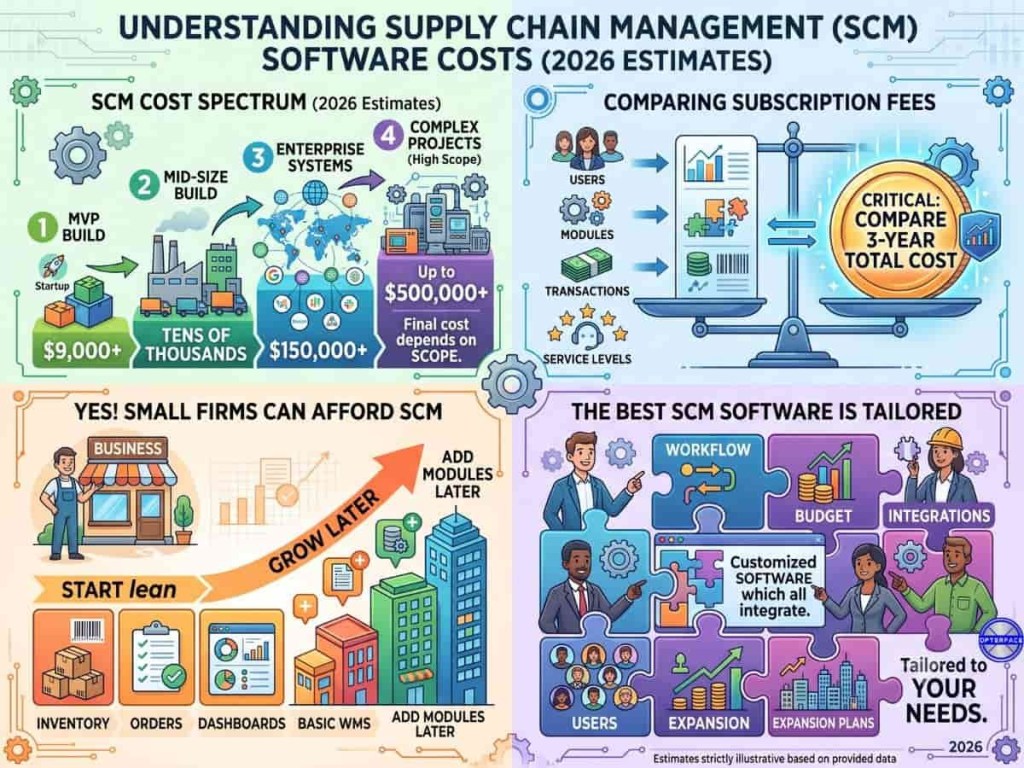
So, how much supply chain management software costs has no single answer. It depends on features, users, integrations, scale, and support, but most importantly, the industry and use cases. Custom supply chain management software can start at around $9,000, while complex enterprise projects or large-scale requirements can exceed $150,000 and even reach $500,000+.
Supply chain management software optimises, tracks, and automates the entire product lifecycle. From raw material procurement to processing, manufacturing, warehousing, logistics, and final delivery to a retail store or directly to the customer’s location, SCM (supply chain management) software serves as a centralised digital system that connects suppliers, manufacturers, storage facilities, logistics, and end users.
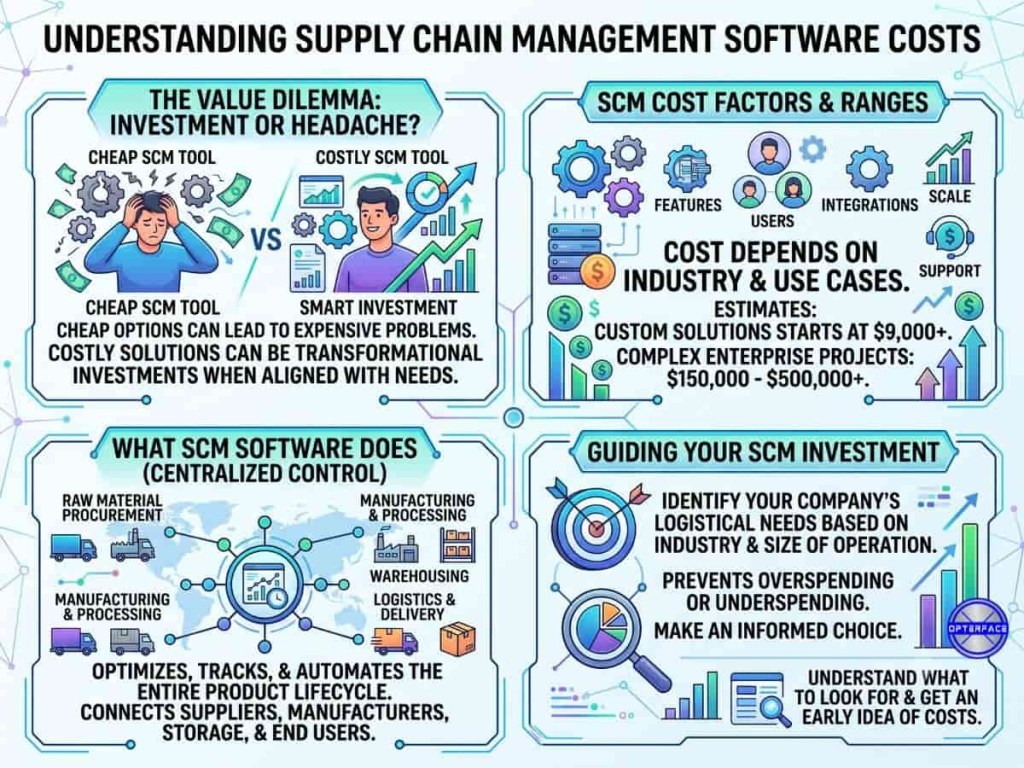
That is why it is critical to identify your company’s logistical needs based on its industry and size of operation. Without prior knowledge, you may overspend or underspend by selecting the incorrect options or supply chain software.
If you’re looking for the best options for your needs, this article will help you understand what to look for in SCM software and give you an early idea of how much supply chain management software will cost.
So, let’s get started!
How Much Does Supply Chain Management Software Cost?
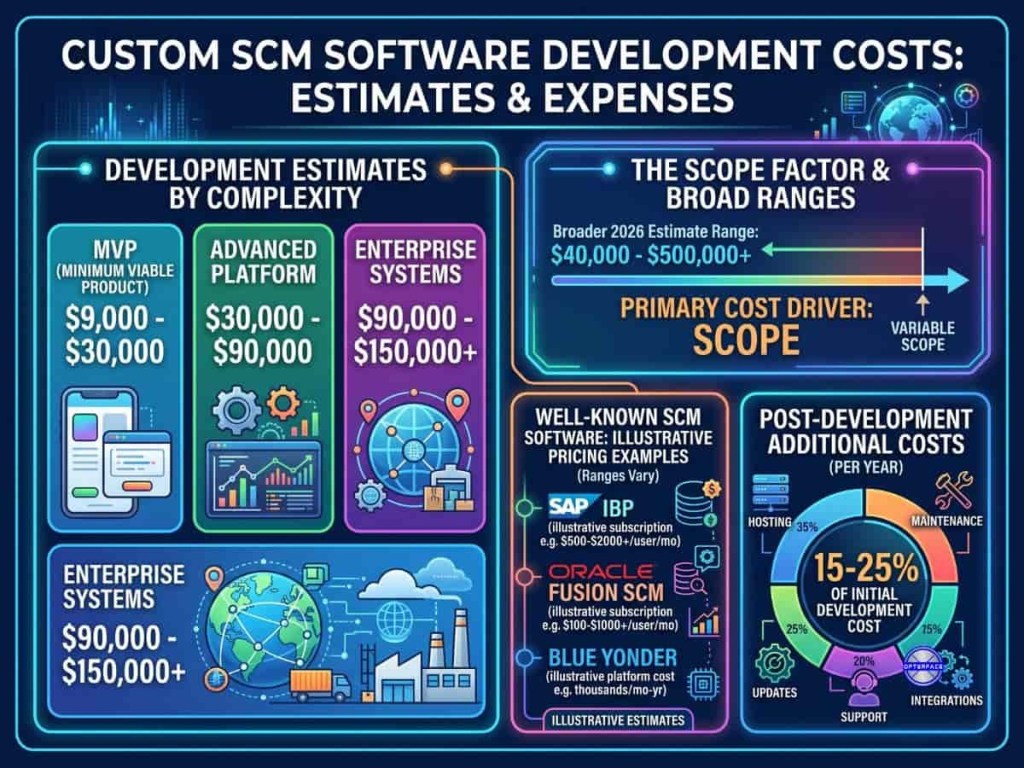
Custom development estimates range from $9,000 to $30,000 for an MVP, $30,000 to $90,000 for an advanced platform, and $90,000-$150,000 or more for enterprise systems. Another 2026 source gives a broader $40,000-$500,000+ range. The primary cause of the gap is scope.
Supply chain management software costs extend beyond development. Hosting, maintenance, updates, support, and integrations can cost an additional 15-25% per year.
Top 5 Supply Chain Management Software Costs
Pricing varies depending on users, modules, transaction volume, implementation, and contract terms. The ranges listed below use current published pricing when available; some enterprise vendors require a custom quote.
- SAP Supply Chain: SAP Supply Chain Base is currently priced at $295 per user per month, while Supply Chain Premium costs $403/user per month. SAP specifies that pricing is displayed for 25-39 users, with a 15-user minimum.
- Oracle Fusion Cloud SCM: Oracle publishes modular prices rather than a single fixed SCM fee. Current examples range from $200/user/month for Advanced Inventory to $1,250/user/month for Supply Planning or Demand Management, with additional SCM modules available separately.
- Microsoft Dynamics 365 SCM: The standard plan costs $210 per user per month, while the Supply Chain Management Premium costs $300 per user per month, both of which are billed annually. In India, Microsoft charges ₹17,470 and ₹24,960 per user/month, before taxes.
- Blue Yonder: Blue Yonder doesn’t publish a standard platform price. Current third-party estimates place enterprise deployments between $500,000 and several million dollars, depending on modules, scale, and implementation.
- Manhattan Active: Manhattan also uses enterprise, quote-based pricing. One current third-party benchmark lists Manhattan Active WM at about $2,000 per user annually, while broader deployments vary with warehouses, modules, users, and transaction volume.
For a realistic comparison, do not compare license prices alone. Implementation, integrations, customization, maintenance, support, and scaling can substantially change the final supply chain management software cost.
For additional cost benchmarks, see Coding Crafts’ supply chain software cost guide and Digital Heroes’ supply chain software cost guide.
How Supply Chain Management Software Reduces Costs Of Business
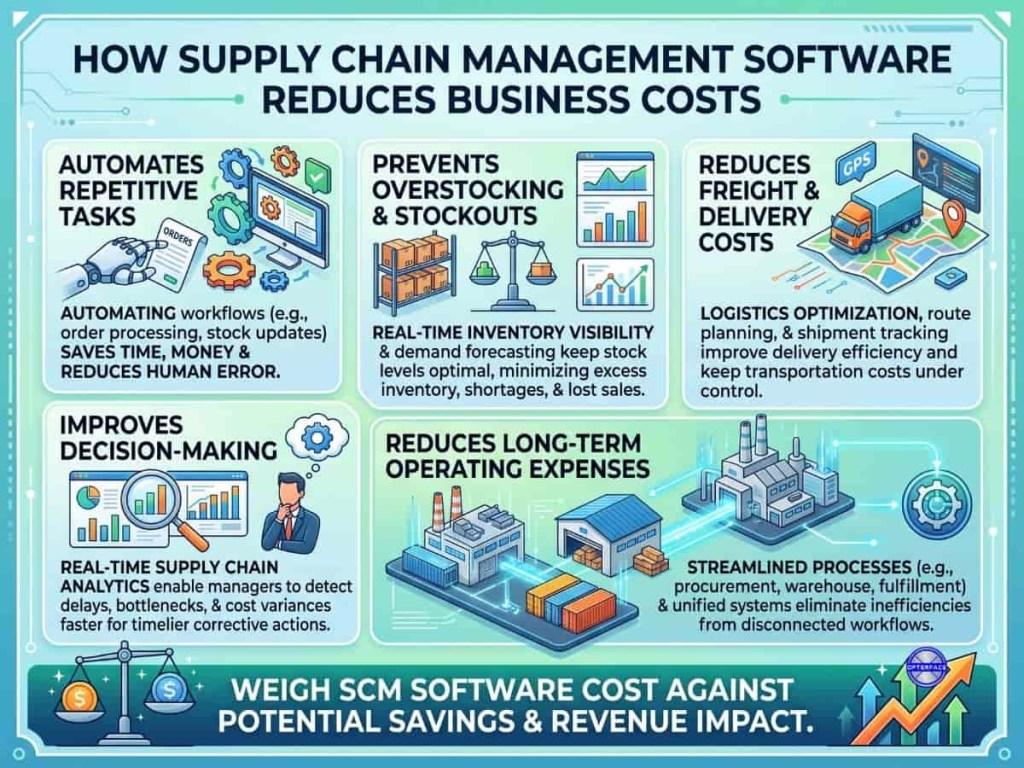
Automation, improved inventory control, fewer errors, faster fulfilment, and real-time visibility all contribute to lower business costs. It can detect low inventory, improve forecasts, track shipments, and reduce manual labour. These gains can reduce labour, transportation, delay, and stockout costs while allowing managers to solve problems sooner.
The main ways supply chain management software reduces costs for businesses are:
Automates repetitive tasks: Automating order processing, stock updates, reporting, and workflows saves time and money and reduces human error.
Prevents overstocking and stockouts: Real-time inventory visibility and demand forecasting help to keep stock levels in check, reducing excess stock, shortages, and lost sales.
Reduces freight and delivery costs: Route planning, shipment tracking, and logistics optimisation can help to reduce delays, increase delivery efficiency, and keep transportation costs under control.
Improves decision-making: Real-time supply chain analytics enables managers to detect delays, bottlenecks, cost variances, and supplier issues earlier, allowing for faster corrective action.
Reduces long-term operating expenses: Custom supply chain management systems can streamline procurement, inventory, warehouse, and fulfilment processes while reducing inefficiencies caused by disconnected systems and unsupported workflows.
That is why the supply chain management software cost should be weighed against the potential savings and revenue impact.
Factors Affecting Supply Chain Management Software Cost
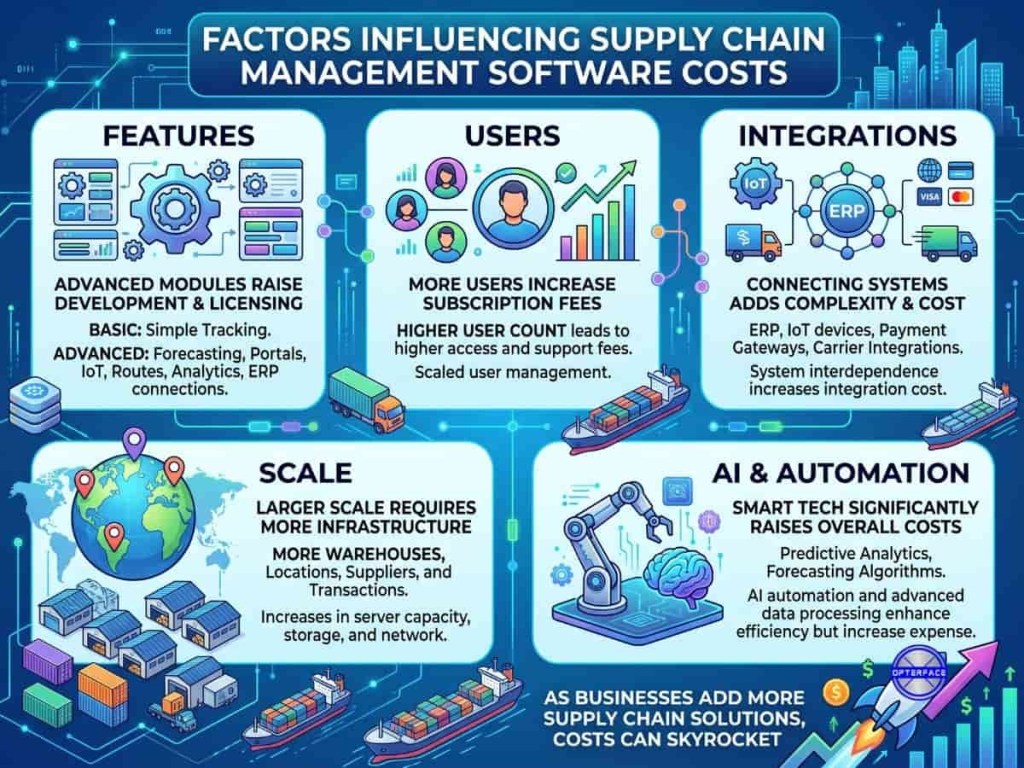
Factors affecting the supply chain management software cost include features, users, locations, data volume, integrations, security, automation, and AI. Basic inventory tracking costs less than a platform with forecasting, supplier portals, IoT, route planning, analytics, and ERP connections. Enterprise operations also need greater scale.
The primary factors influencing the supply chain management software cost include:
- Features: More advanced modules raise development and licensing costs.
- Users: More users can increase subscription, access, and support fees.
- Integrations: ERP, IoT, payment, and carrier integrations increase complexity and cost.
- Scale: As the number of warehouses, locations, suppliers, and transactions increases, so does the infrastructure.
- AI and Automation: Predictive analytics, forecasting, and AI automation can significantly raise overall costs.
These factors explain why supply chain management software costs can skyrocket as businesses add more supply chain solutions.
Cost Of Inventory Control Software For Supply Chain Management
The cost of inventory control software for supply chain management is determined by the level of inventory control required. Basic systems keep track of stock and orders. Advanced systems include forecasting, multi-location visibility, alerts, IoT, and ERP integration. Small businesses can start lean. Larger companies require greater control over warehouses, suppliers, and stores.
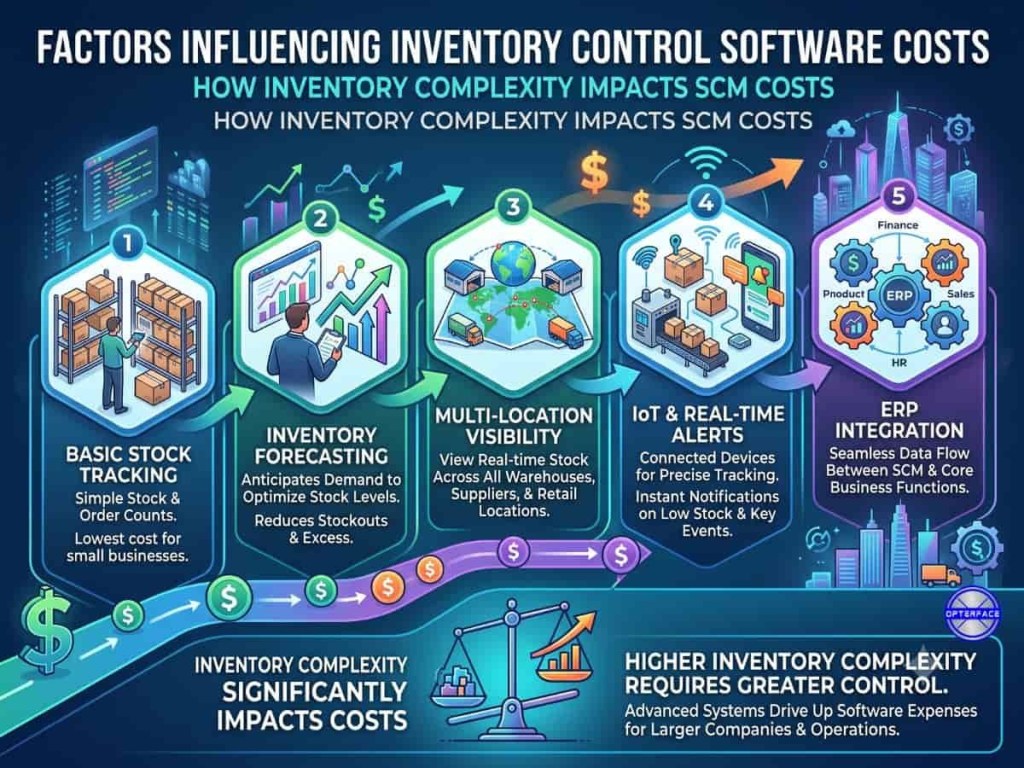
The primary factors influencing the cost of inventory control software for supply chain management are:
- Basic Stock Tracking
- Inventory Forecasting
- Multi-location visibility
- IoT & Real-time Alerts
- ERP Integration
As a result, inventory complexity has a significant impact on supply chain management software costs.
Comparing Cost Of Food SCM Products
Comparing the Cost of Food Supply Chain Management Software Products requires more than just comparing licence prices. Food businesses may require cold-chain management, lot tracking, supplier management, warehouse control, and shipment visibility. The ideal product should minimise spoilage, waste, delays, and compliance risks.
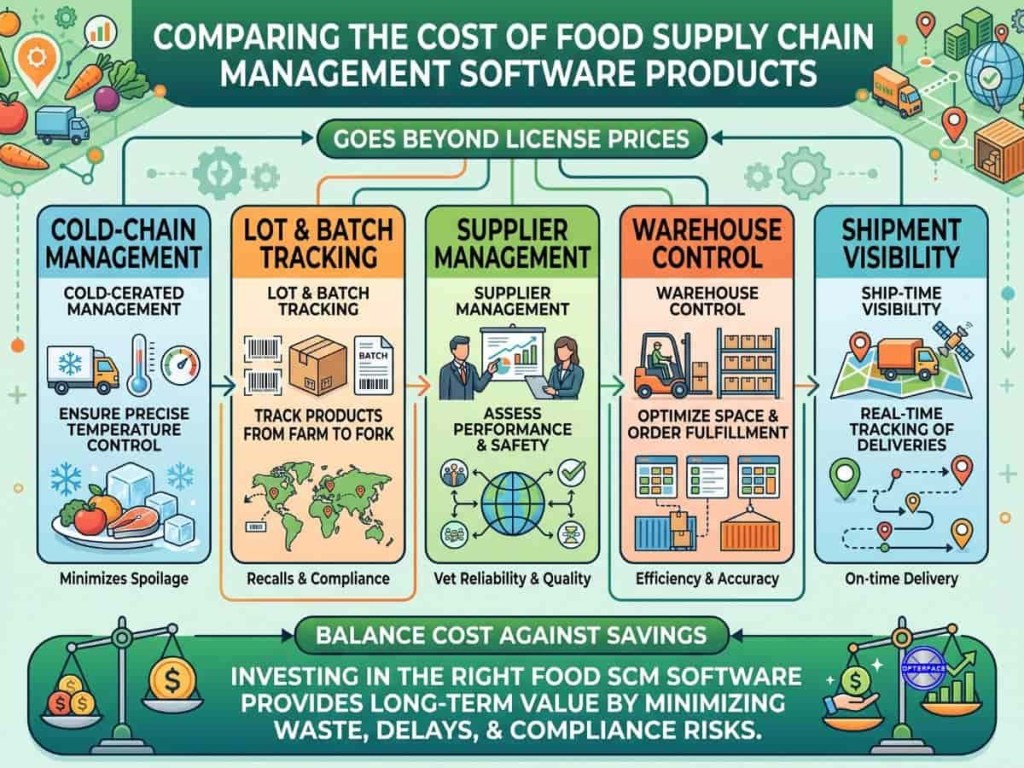
When comparing the cost of food supply chain management software, consider the following key factors:
- Cold-Chain Management
- Lot & Batch Tracking
- Supplier Management
- Warehouse Control
- Shipment Visibility
Thus, the cost of food supply chain management software should be balanced against the savings it can provide.
Freight Cost Optimization Software Comparison
For freight cost optimisation, a supply chain manager’s software comparison should include route planning, carrier data, shipment tracking, freight analytics, and automation. Compare integration effort, reporting, scalability, and projected savings. A feature-rich tool is worthless if your team cannot access its data.
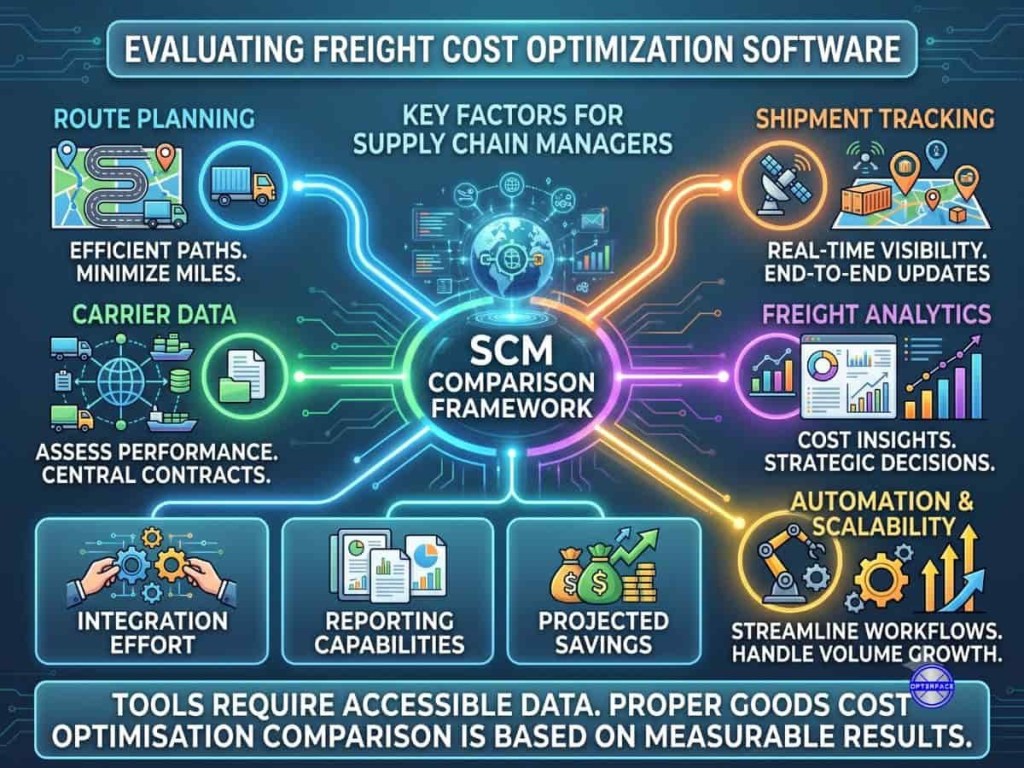
Supply chain managers should compare the following key factors when comparing freight cost optimisation software:
- Route Planning
- Carrier Data
- Shipment Tracking
- Freight Analytics
- Automation & Scalability
A proper goods cost optimisation software comparison for supply chain managers is based on measurable results.
How To Reduce Supply Chain Management Software Cost?
Start with the core workflow. Avoid buying every module on day one. Compare total ownership cost, not just subscription price. Plan integrations early. Use modular design. Clear requirements also reduce scope creep, rework, and unnecessary development.
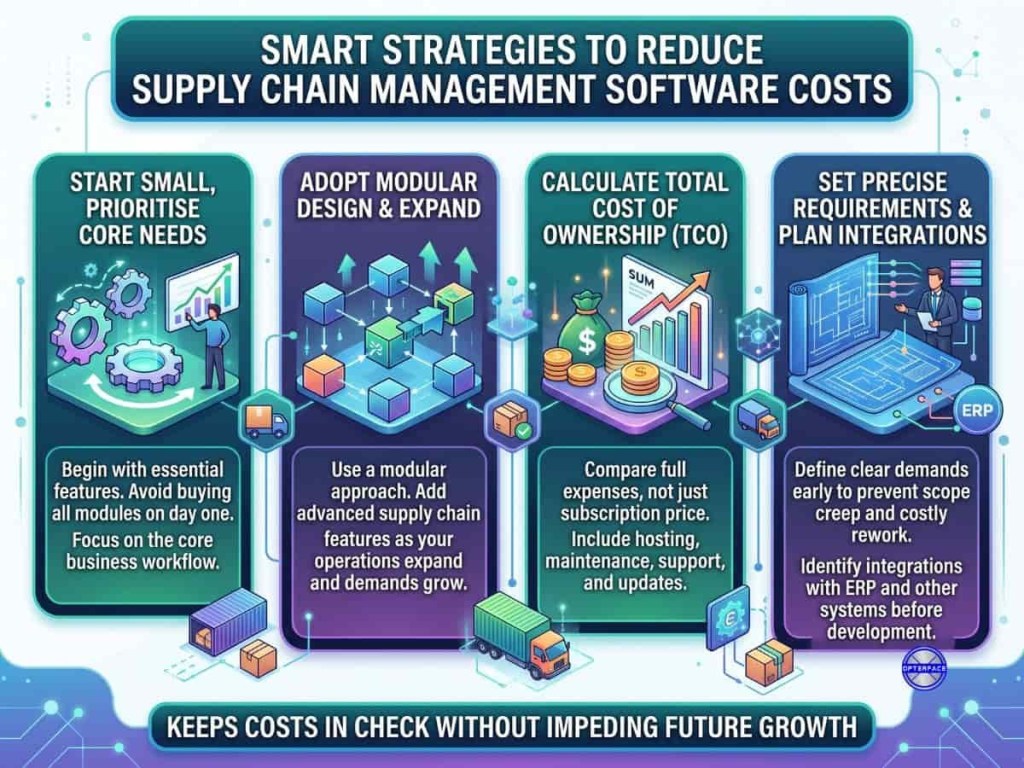
The key strategies for reducing supply chain management software costs are:
- Begin Small: Prioritise the core features required by your business.
- Modularise: Add advanced modules as your supply chain expands.
- Plan Integrations: Define ERP and third-party integrations before starting development.
- Compare Total Costs: Consider subscriptions, hosting, maintenance, support, and upgrades.
- Set Clear Requirements: Having precise requirements helps to prevent scope creep and costly rework.
This keeps supply chain management software costs in check without impeding future growth.
Useful research may also include Quora’s supply chain planning software discussion and this supply chain planning video.
Build Or Buy?
The supply chain management software cost varies significantly between SaaS and custom development. Off-the-shelf SCM platforms provide faster deployment and predictable subscriptions. Custom platforms are more expensive upfront, but they can accommodate unusual workflows and complex ERP or IoT integrations.
For a broader range of software options, IndiaMART’s SCM software directory can aid in vendor discovery.
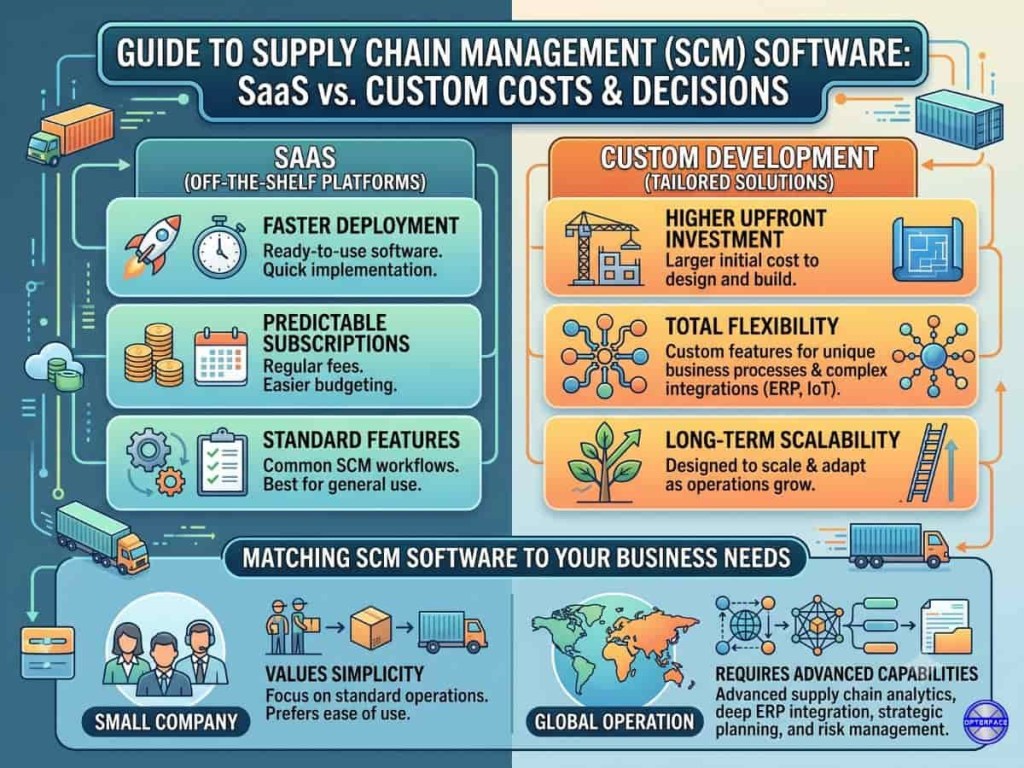
A small company may value simplicity. A global operation may require advanced supply chain analytics, ERP integration, supply chain planning, and supply chain risk management.
The cost of the appropriate supply chain management software is determined by this difference.
AI Is Changing SCM
AI is now a component of supply chain management. Demand forecasting and predictive planning can increase development costs while also improving decision-making. Current source material identifies AI-driven forecasting and planning as significant cost drivers.
So, will artificial intelligence replace supply chain management? No. AI is more likely to become a layer of SCM software. It can help with supply planning, supply chain optimisation, and risk management while keeping people accountable.
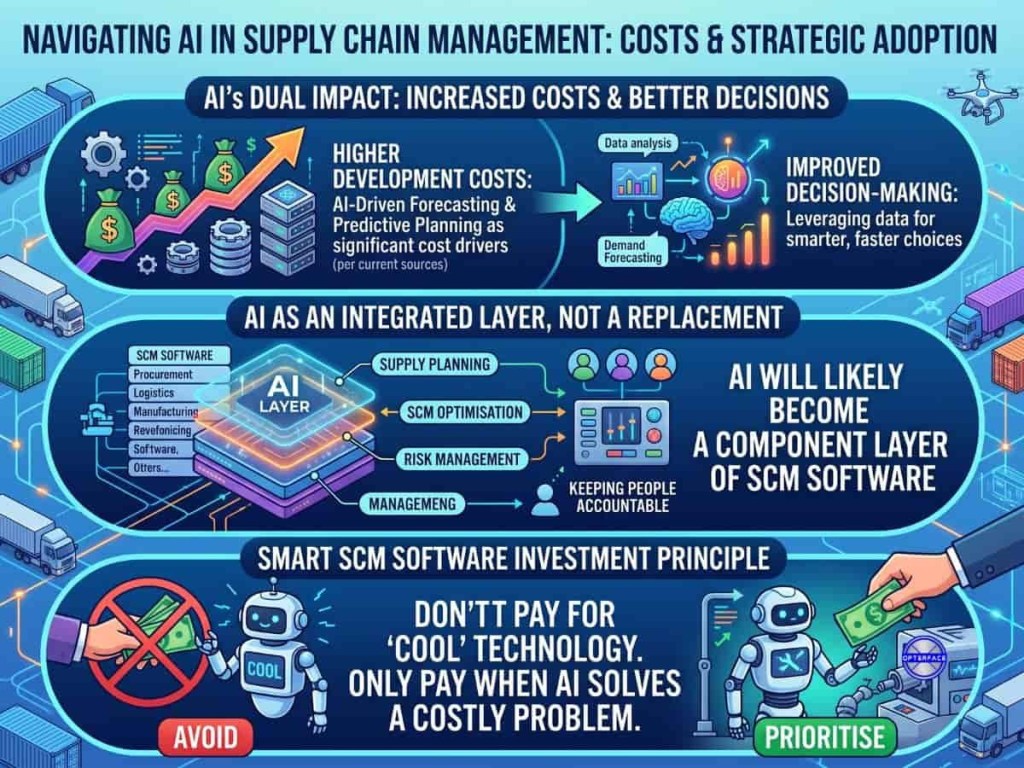
That is important in terms of supply chain management software costs. Don’t pay for AI just because it sounds cool. Pay when it solves a costly problem.
FAQs on Supply Chain Management Software Cost
Cost is only one factor in the decision. These frequently asked questions address pricing, subscriptions, affordability, software selection, and custom development costs. Use them to compare options with confidence and avoid unexpected expenses.
Here are some quick answers to the most frequently asked questions about supply chain management software costs:
What Is The Average Price Range of SCM Software?
The supply chain management software cost ranges from around $9,000 for an MVP to more than $150,000 for enterprise systems. Complex projects can cost significantly more.
How Do Subscription Fees Compare?
Costs for supply chain management software vary depending on the number of users, modules, transactions, and service levels. Compare the total three-year cost.
Can Small Firms Afford SCM?
Yes. Inventory, orders, and dashboards are common starting points for small business supply chain management software. More modules can be added later.
What Is The Best SCM Software?
There is no universal winner. The best supply chain software is tailored to your workflow, budget, integrations, users, and expansion plans.
How Much Does It Cost to Build Supply Chain Management Software in 2026?
How much does it cost to develop supply chain management software in 2026? The published estimates range from tens of thousands for smaller builds to more than $500,000 for complex systems. The final figure is determined by the scope of work.
Conclusion On Supply Chain Management Software Cost
The best approach is to tailor the software to your specific supply chain requirements rather than chasing the longest feature list. Begin with essential workflows, track savings, and scale the platform as your operations expand.
Whether you choose an off-the-shelf solution or custom development, prioritise integration, usability, automation, and long-term value. The best investment is not necessarily the cheapest system. It is the one that generates measurable savings while avoiding new operational headaches.
The actual supply chain management software cost is not reflected in the invoice. It is the cost of solving the problem incorrectly.
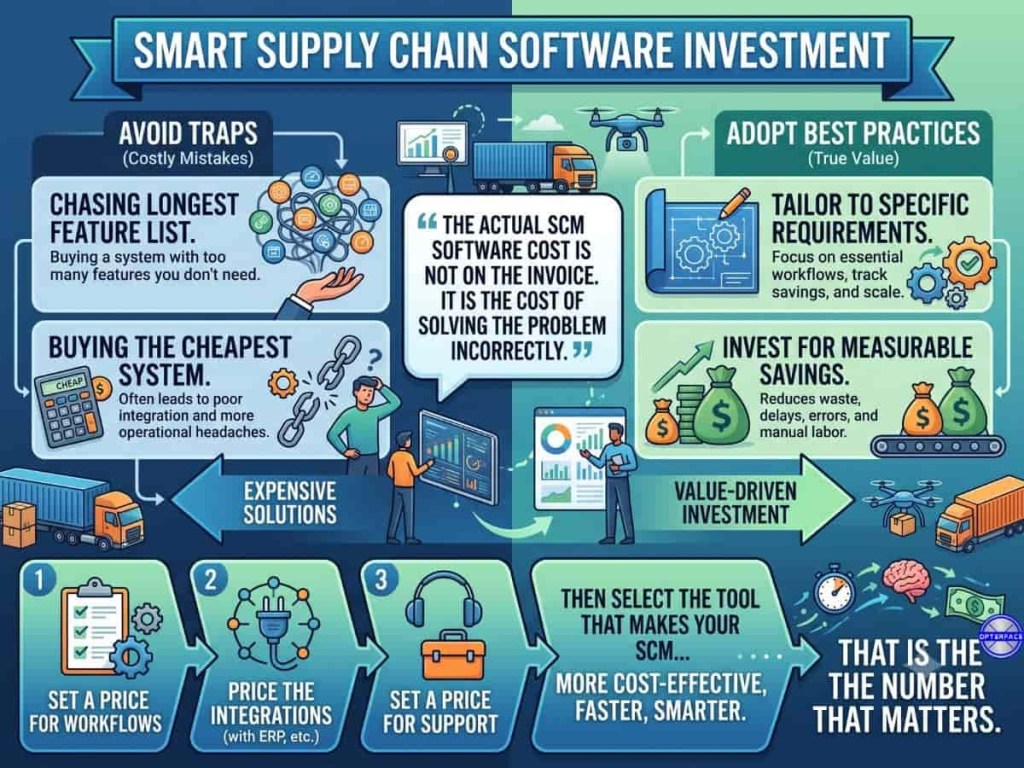
A low-cost system that does not integrate with your ERP can be expensive. A larger investment to reduce waste, delays, errors, and manual labour may pay for itself.
Set a price for the workflow. Price the integrations. Set a price for support.
Then select the tool that will make your supply chain operations more cost-effective, faster, and smarter.
That is the number that really matters.
Suggested Reads:
- Top 5 IaaS Startup Ideas as AI Changes Infrastructure as a Service
- NVIDIA Case Study: Journey of a Gaming Brand to a Tech Giant
- How to Rank on AI Overviews: Boost Your AI Visibility & Authority
- Problems with the AI Content Creation Process and Their Fixes
- Digital Marketing Trends in 2026: Process of Content Creation to Win
- The Digital Marketing Mindset for 2026 and Beyond: What Truly Matters?
 OPTERFACE