
Problems with the AI content creation process are explained in this blog, with practical fixes to improve content quality.
Introduction to Problems with the AI Content Creation Process
The modern AI content creation process has produced an unusual paradox. Why are more content creators creating more content but receiving poorer results? Making content has never been easier. Content distribution has never been faster.
However, many marketers, agencies, businesses, and creators are struggling to maintain the same levels of engagement they once had. T
They’re publishing more articles, social media posts, newsletters, and landing pages than ever before, using multiple AI content creation processes. However, despite the increased output, the results are often disappointing.
Traffic arrives, but no conversions occur. Impressions increase, but engagement decreases. Content is published, but audiences rarely remember it.
If this sounds familiar, you’re not alone. The issue isn’t artificial intelligence itself. The issue is how people approach the AI content creation process.
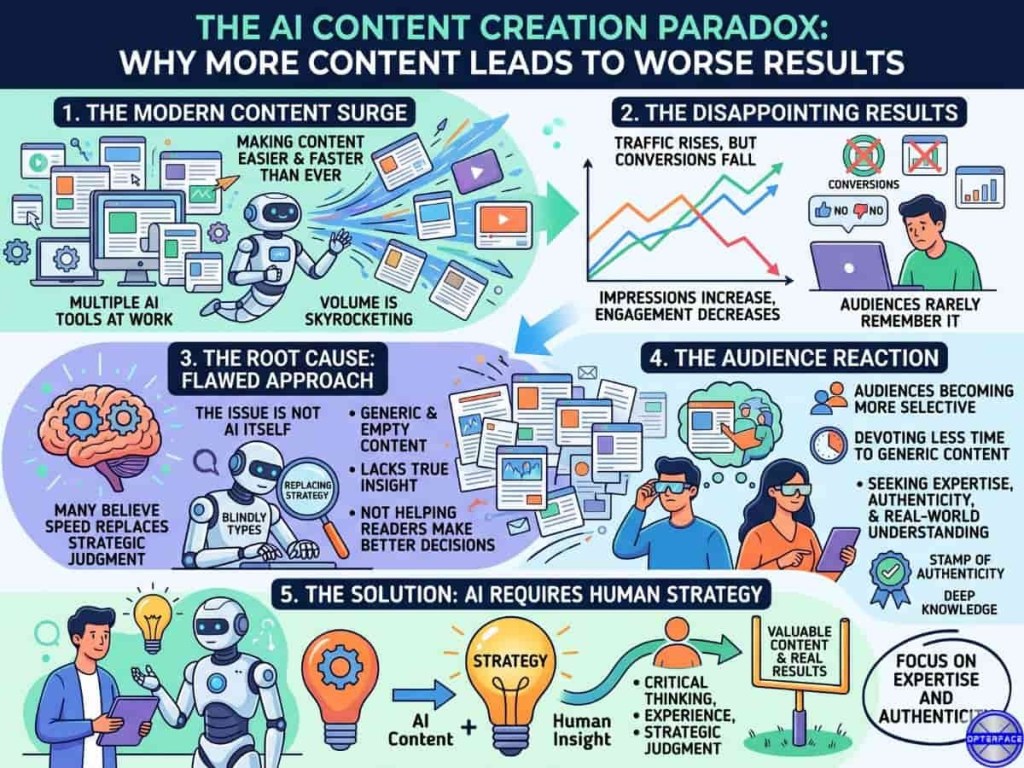
Many marketers believe that because the AI content creation process can generate thousands of words in minutes, it can replace the critical thinking, experience, and strategic judgement required to create valuable content.
Unfortunately, this assumption leads to one of the most severe content quality crises in the history of the digital marketing industry.
The AI content creation process is ineffective without a strategy. The internet is becoming increasingly crowded with content that appears polished but feels empty.
Content that appears informative but lacks true insight. Content that answers questions but does not help readers make better decisions.
As a result, audiences are becoming more selective about the content they consume. They are devoting less time to generic content and instead looking for content that demonstrates expertise, authenticity, and real-world understanding.
Understanding the strengths and weaknesses of the AI content creation process is critical.
What Is the Real Problem with AI-Generated Content?
Ask ten marketers about the problems with AI-generated content, and you’ll probably get ten different answers. Some will blame the AI content creation process for producing content with factual errors.
Others will point out repetitive language. Some will emphasise the importance of originality. While all of these issues are important, they are symptoms rather than the underlying cause.
The real issue with the AI content creation process is that many people treat AI as a replacement for thinking rather than a tool for improving thinking. Artificial intelligence can process information.
AI can recognise patterns. AI can generate text. But AI models lack the level of human understanding due to a lack of real-world experience.
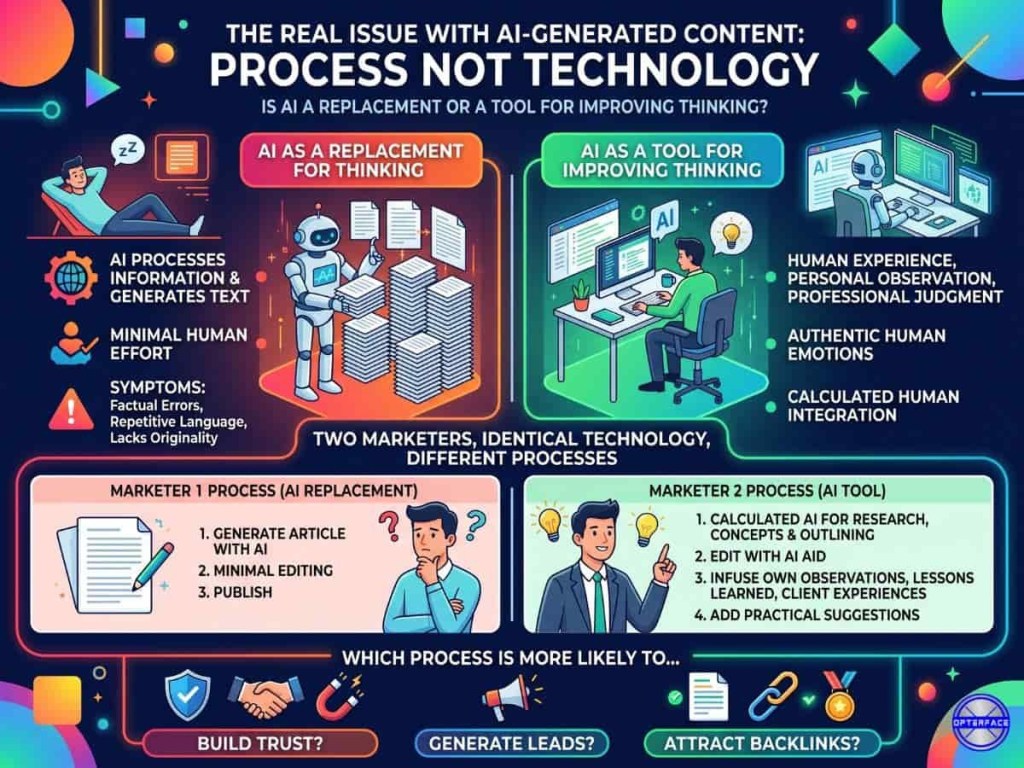
However, the AI content creation process cannot replace lived experience, personal observation, professional judgement, or an authentic understanding of human emotions.
That distinction is more important than most people realise. Consider two marketers writing about SEO strategy with their personal insights based on their individual experiences.
The first marketer creates an article using AI and publishes it with minimal editing. The second marketer employs a calculated AI content creation process for research, concept generation, outlining, and editing.
They then include their own observations, lessons learned, client experiences, and practical suggestions.
- Which article is more likely to build trust?
- Which article is most likely to generate leads?
- Which article is more likely to attract backlinks?
The answer is obvious. The technology is identical. The difference is in the process.
Why Does the Quality vs Quantity Trap Destroy Content Performance?
One of the most serious risks of the modern AI content creation process is the temptation to prioritise volume over quality. For many businesses, AI represents a productivity superpower.
Instead of publishing four articles each month, they can publish forty. Instead of ten social posts per week, they can make one hundred.
Initially, the results seem impressive. There is a significant increase in content production. Teams feel productive. Clients see more deliverables.
Everyone seems happy. Then something strange occurs. The level of engagement begins to fall. Bounce rates rise. And you don’t know what was wrong with your AI content creation process.
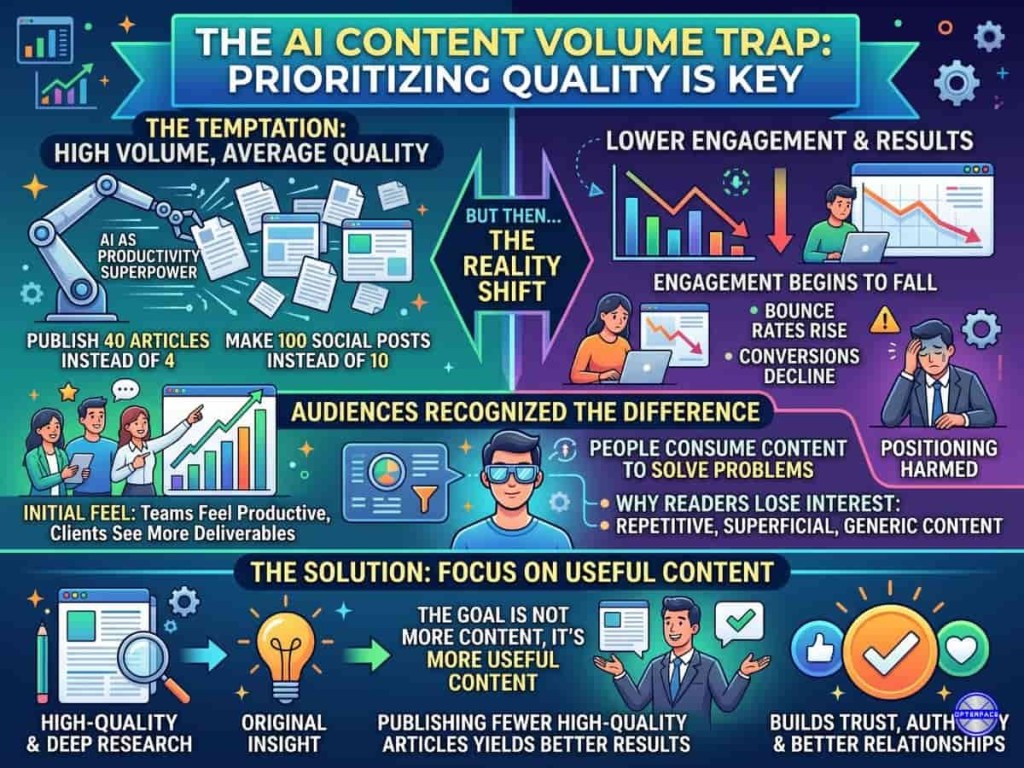
Readers spend less time per page. Conversions are declining. Instead of benefiting, the AI content creation process harmed your positioning. The solution is simple.
The audience recognised the difference before the creator did. People don’t consume content simply because it exists. People consume content to solve problems.
When content becomes repetitive, superficial, or generic, readers quickly lose interest. This is why many organisations find that publishing fewer high-quality articles yields better results than publishing dozens of average ones.
The goal isn’t to generate more content. The goal is to generate more useful content.
What Happens When You Depend Entirely on AI?
Many marketers are fascinated by automation. They learn about AI blog automation, automatic content generation, and advanced AI prompts for content creation. Suddenly, an entire month’s worth of content can be created in just hours.
The efficiency feels incredible. The problem is that efficiency and effectiveness are not synonymous. A content workflow designed entirely around AI frequently develops several hidden flaws. So let’s understand the problems in the AI content creation process.
Problem #1: Generic Content Everywhere
One of the most prevalent issues with AI-generated content is a lack of uniqueness. AI learns from patterns that are already available online.
As a result, many AI-generated articles sound very similar. The wording changes. The formatting changes.
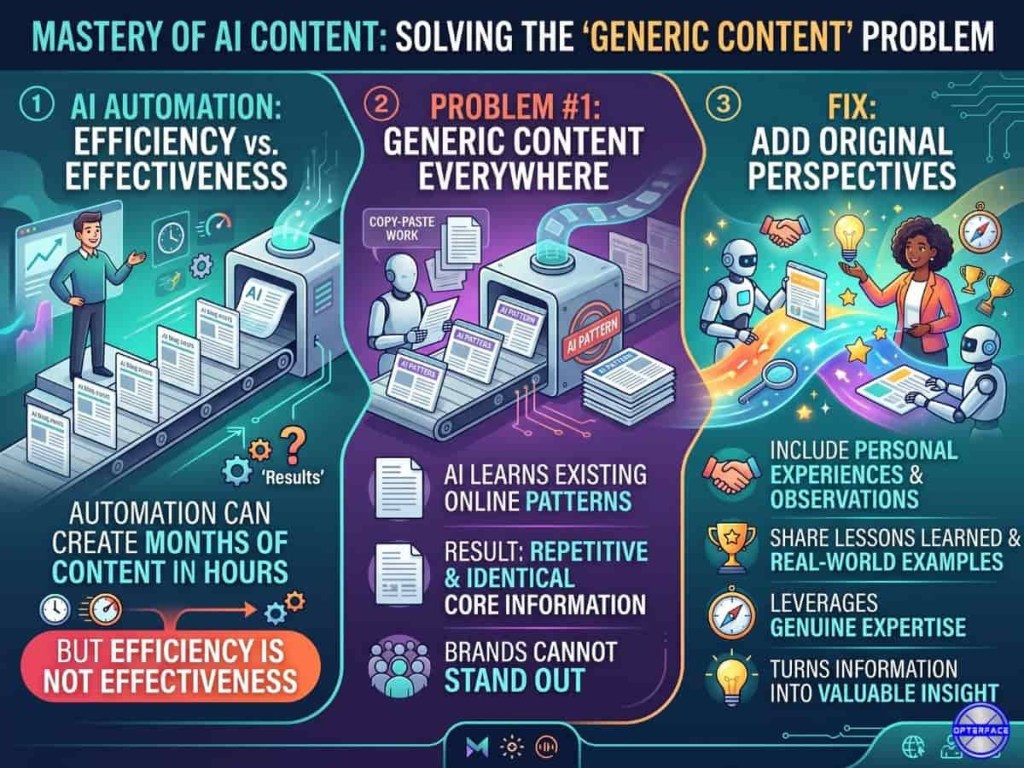
However, the core information remains almost identical. This presents a significant challenge for brands looking to differentiate themselves.
If your content sounds similar to everyone else’s, why should anyone remember it?
Fix: Add Original Perspectives
The solution is surprisingly simple. Include experiences. Include observations. Include the lessons learned. Provide examples from real-world situations.
These elements are difficult to replicate because they are based on genuine expertise. This is how information becomes insight.
Problem #2: Context Doesn’t Match Reality
Another significant issue with AI-generated content is contextual accuracy. AI can provide technically correct information while completely overlooking the real-world scenario.
It frequently struggles to grasp industry nuances, audience expectations, business goals, regional variations, and current market conditions.
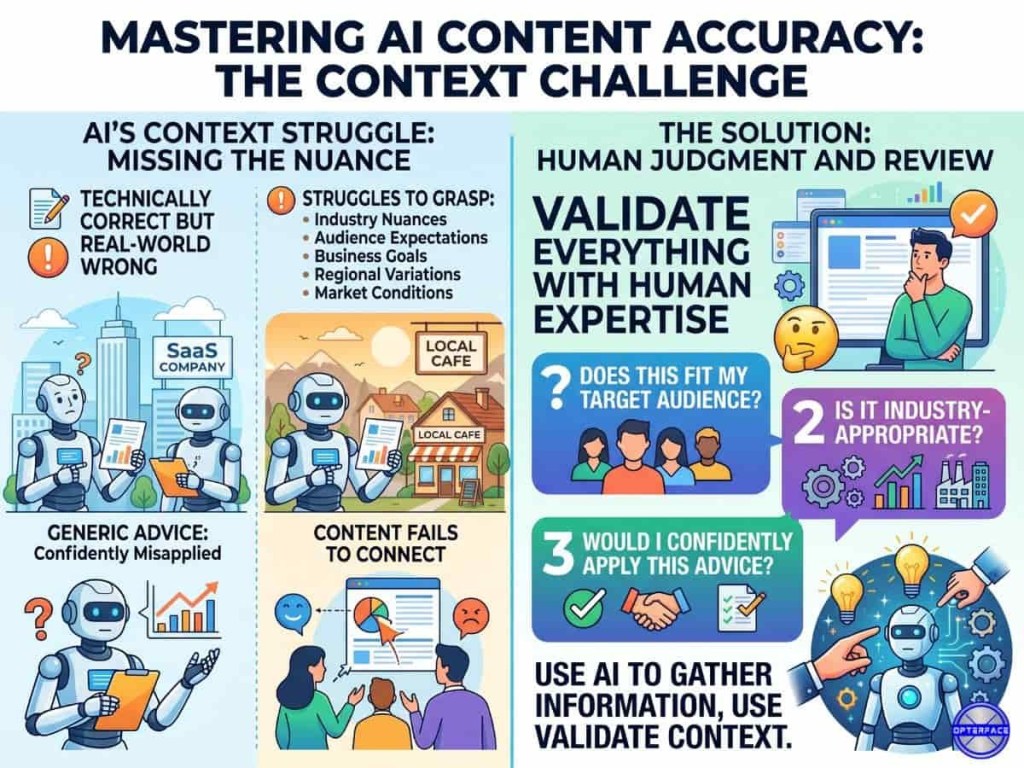
For example, a strategy that works perfectly for a SaaS company may not work for a local service business.
However, AI may present both solutions with equal confidence. This results in content that sounds intelligent but fails to connect with the reader.
Fix: Review Everything Through Human Judgment
Before you publish, ask yourself:
- Does this recommendation make sense to my target audience?
- Is it in line with my industry?
- Would I be able to apply this advice confidently?
Use AI to gather information, but use human expertise to validate context.
Problem #3: Weak brand Voice and Personality
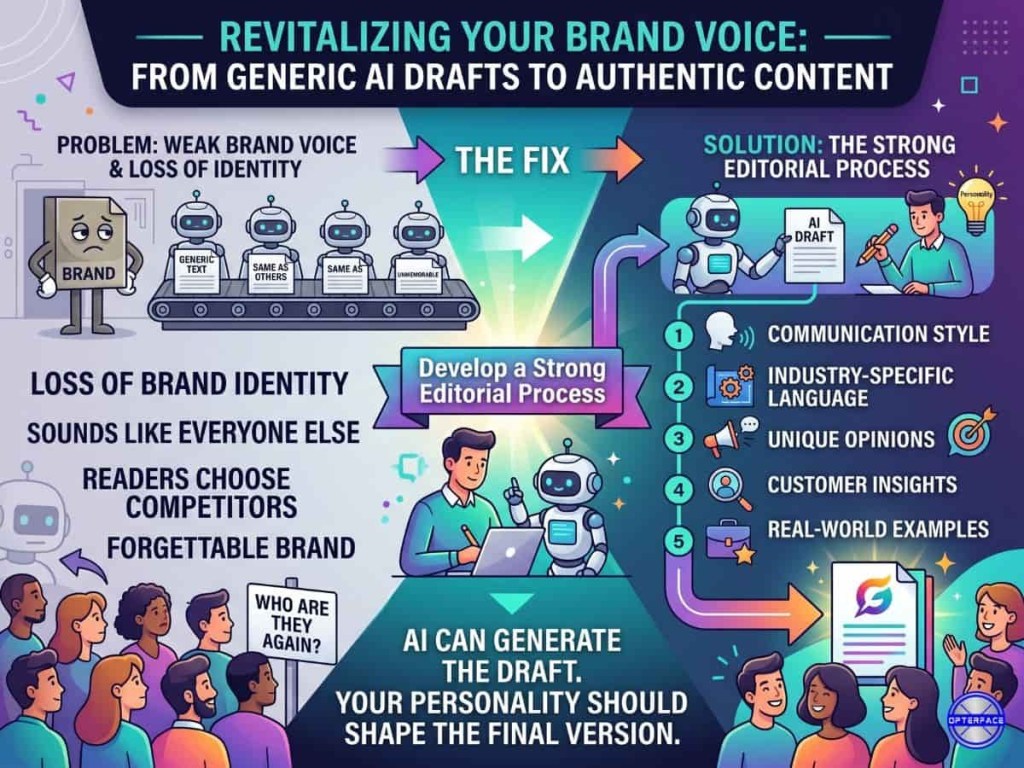
Many businesses spend years developing a recognisable voice. Then they use AI to create content that sounds identical to everyone else. The result is a loss of identity.
Your audience follows you because of your viewpoint, communication style, and expertise. If your content is generic, readers will have no reason to choose you over a competitor. Over time, your brand becomes forgettable.
Fix: Develop a Strong Editorial Process
Never publish AI-generated content without editing it to match your brand’s tone. Add:
- Your Communication Style
- Industry-specific language
- unique opinions
- Customer insights.
- Real-world examples
AI can generate the draft. Your personality should shape the final version.
Problem #4: Information Overload Without Value
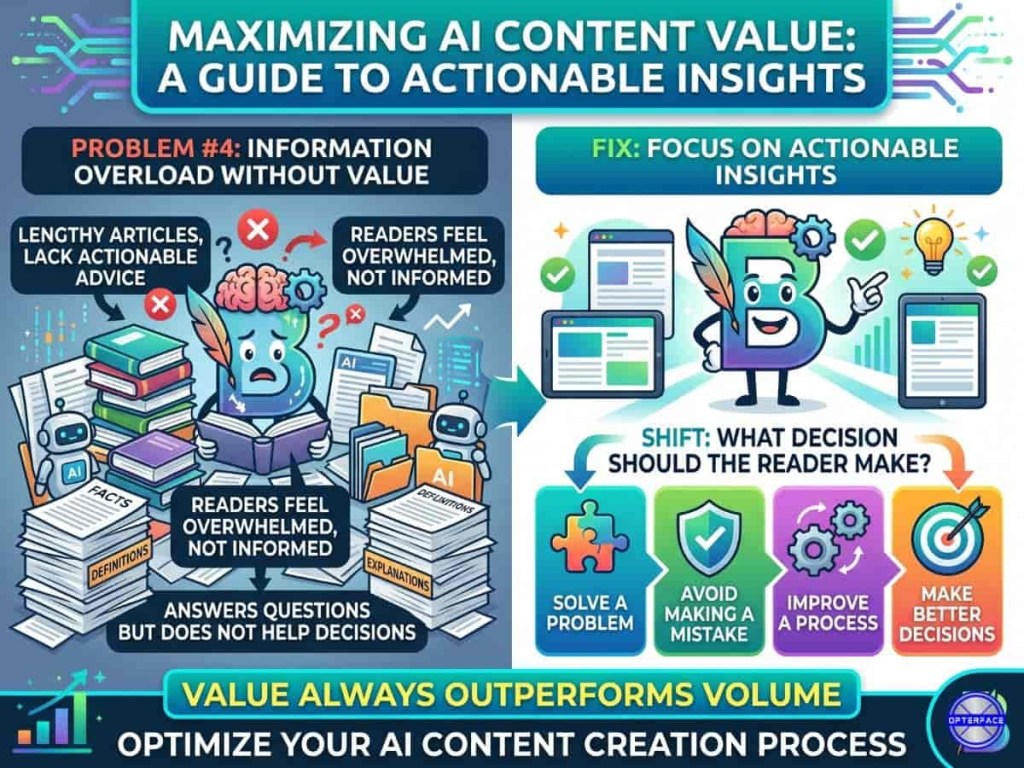
AI is fantastic at generating data. Unfortunately, additional information does not always result in better content. Many AI-generated articles become lengthy collections of facts, definitions, and explanations that lack actionable advice.
Readers leave feeling more overwhelmed than informed. The content answers questions but does not help readers make decisions.
Fix: Focus on Actionable Insights
Instead of asking, “What information should I include?” Question: “What decision should the reader be able to make after reading this?” Each section should benefit the audience:
- Solve a problem.
- Avoid making a mistake.
- Improve a process.
- Make better decisions.
Value always outperforms volume. So, you have to optimize your AI content creation process accordingly before it’s too late!
Problem #5: Reduced Trust Due to Inaccuracies
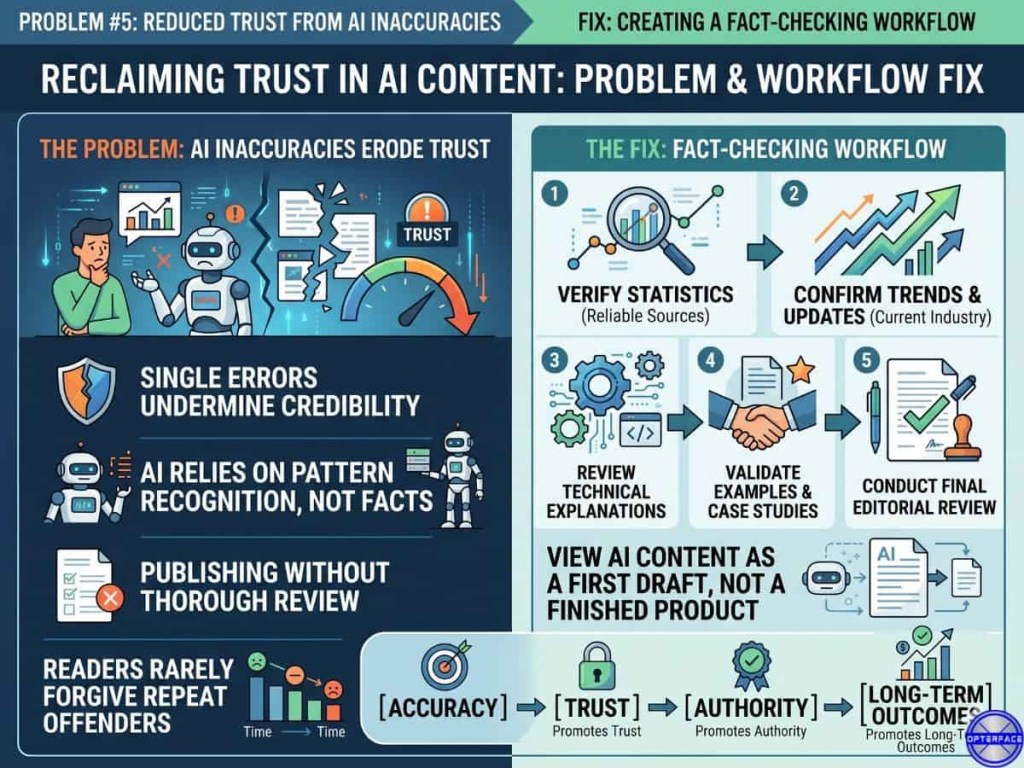
A single incorrect statistic, outdated recommendation, or misleading statement can undermine credibility. AI systems can produce inaccurate information because they rely on pattern recognition rather than fact verification.
The problem worsens when marketers publish content without thoroughly reviewing it. Readers may forgive minor errors. They rarely forgive repeat offenders. Once trust has been lost, it is difficult to recover.
Fix: Create a Fact-Checking Workflow
Before publication:
- Verify statistics from reliable sources.
- Confirm current industry trends and updates.
- Review the technical explanations.
- Validate the examples and case studies.
- Conduct a final editorial review.
The most successful creators view AI-generated content as a first draft, not a finished product. Accuracy promotes trust. Trust promotes authority. Authority promotes long-term outcomes.
Why Is Context One of AI’s Biggest Weaknesses?
Context is another issue that is often overlooked when creating AI content. AI can often provide accurate data. However, accurate information isn’t always useful. Context determines whether a recommendation is appropriate for a specific target audience, industry, location, or business goal.
For example, a strategy that works for a software startup may not work for a local service business. Similarly, tactics that work well in one country may not be effective in another. AI frequently struggles with such nuances. This creates a dangerous situation.
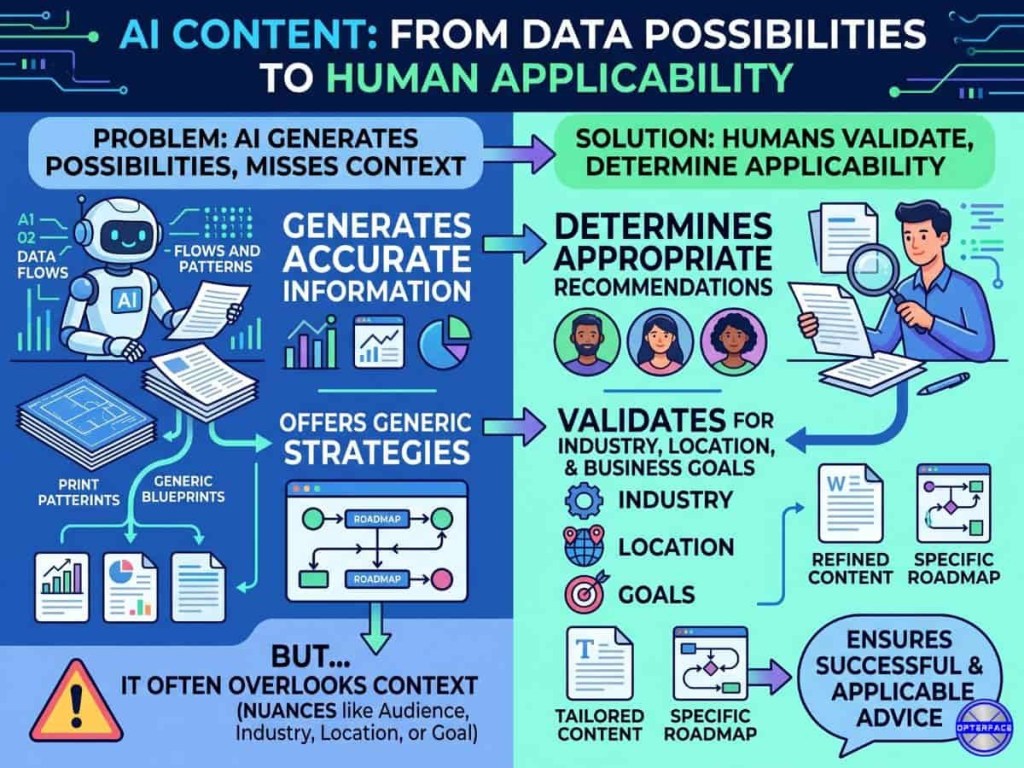
The content may appear correct. The advice may seem logical. However, the recommendation may still be incorrect for the reader’s specific situation.
That is why human review remains necessary. Your AI content creation process can create possibilities. But you must determine applicability.
What Do Great Content Creators Understand About AI That Others Miss?
The most successful marketers rarely see AI as a replacement. Instead, they consider it an enhancement layer. They recognise that the true value of AI is not in creating content for them.
The true value of the AI content creation process is in allowing them to think faster, research faster, organise faster, and edit faster.
The most powerful creators begin with human insight. Then they apply AI to improve execution. They understand how audiences respond to stories, experiences, lessons, mistakes, and perspectives. These elements remain distinctively human.
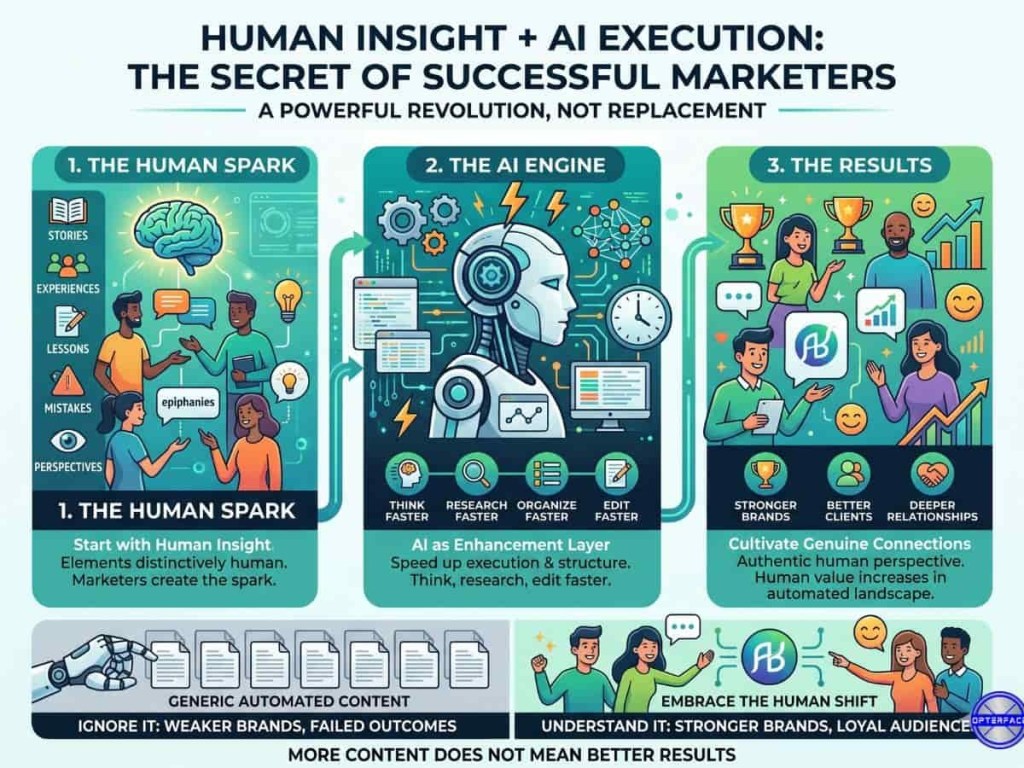
And, in a digital landscape flooded with automated content, the human perspective is becoming more valuable, not less.
Marketers who understand this shift are building stronger brands, attracting better clients, and cultivating deeper relationships with their audiences.
Marketers who ignore it frequently discover that more content does not necessarily produce better results.
What Is the AI Problem of Context and Accuracy?
One of the most dangerous flaws in the modern AI content creation process is the disconnect between information and comprehension. AI can provide an answer in seconds.
It has an impressive ability to summarise research, identify trends, and explain concepts quickly. However, speed does not guarantee accuracy, nor does accuracy guarantee relevance.
Context plays an important role here. Consider a digital marketer looking for advice on increasing conversion rates. Your AI content creation process may generate a list of best practices based on data gathered from thousands of sources.
The recommendations may be technically correct. However, they may not be appropriate for the marketer’s target audience, industry, budget, or business model.
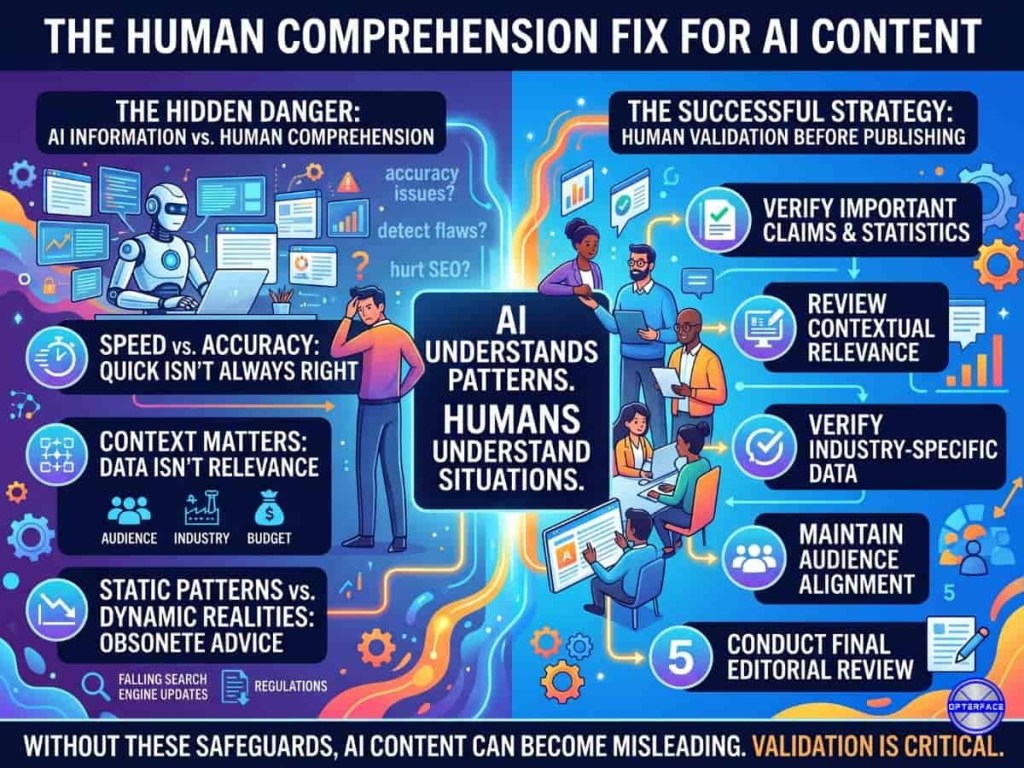
That is the hidden challenge. AI understands patterns. Humans understand situations. The issue becomes even more apparent in industries where information changes quickly.
New search engine updates, shifting consumer behaviour, changing privacy regulations, and emerging marketing technologies can render previously useful advice obsolete.
This is why many marketers are asking:
- How do major companies deal with AI content accuracy issues?
- How do you detect flaws in AI content for marketing?
- Does AI content marketing hurt SEO?
The answer is that successful organisations do not rely solely on AI-generated results. They use AI to accelerate research and execution, but they always validate the data before publishing. The most effective AI content review process involves:
- Verifying important claims and statistics.
- Reviewing recommendations for contextual relevance.
- Verifying industry-specific data.
- Maintaining consistency with audience expectations.
- Conducting a final editorial review.
Without these safeguards, even the best-written article can become misleading.
What Is the Right Way to Use AI?
The right approach to the AI content creation process is surprisingly straightforward. Utilise AI as an assistant. Do not use AI to replace your expertise. Many marketers view AI as a content factory.
They enter a prompt, create a draft, make minor changes, and publish right away. Although this saves time, it frequently yields average results.
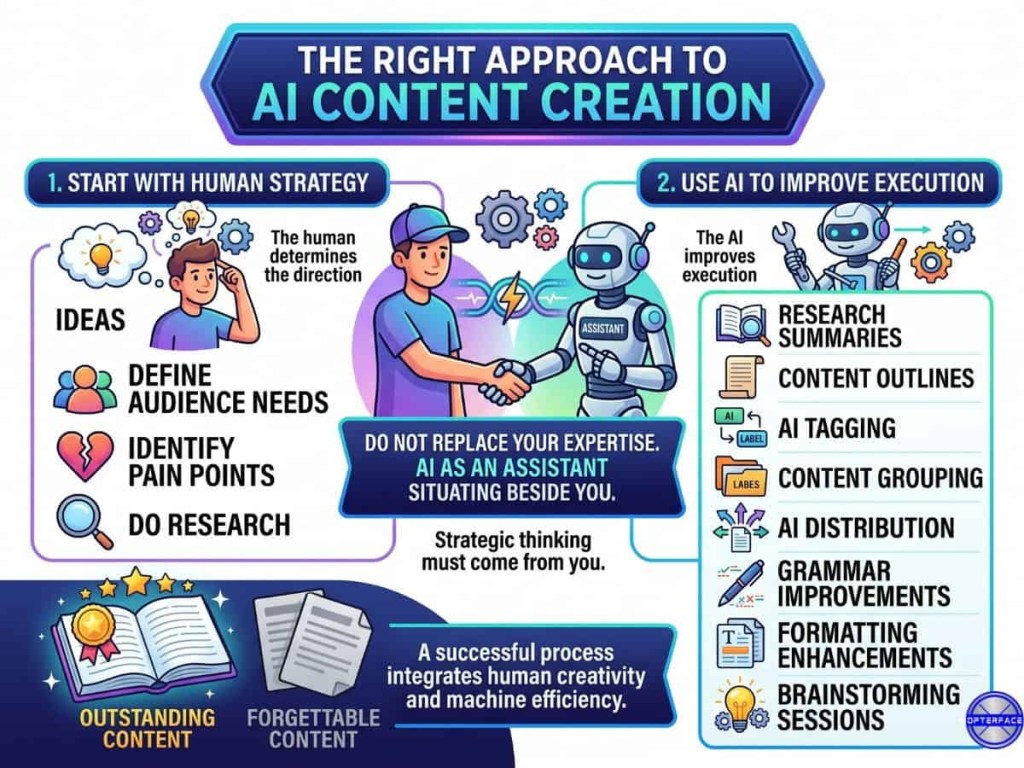
The best creators use a different process. They start with ideas. They define the audience’s needs.
They identify pain points. They do research. Only then do they apply AI to improve execution. Imagine AI as a highly capable assistant sitting beside you.
It may help with:
- Research summaries
- Content Outlines
- AI content tagging
- AI Content Grouping
- AI Content Distribution
- Grammar Improvements
- Formatting enhancements
- Brainstorming sessions
However, strategic thinking must continue to come from you. A successful generative AI content creation process integrates human creativity and machine efficiency.
The human determines the direction. The AI improves execution. This distinction separates outstanding content from forgettable content.
What Are Effective AI-Powered Content Creation Process Tips?
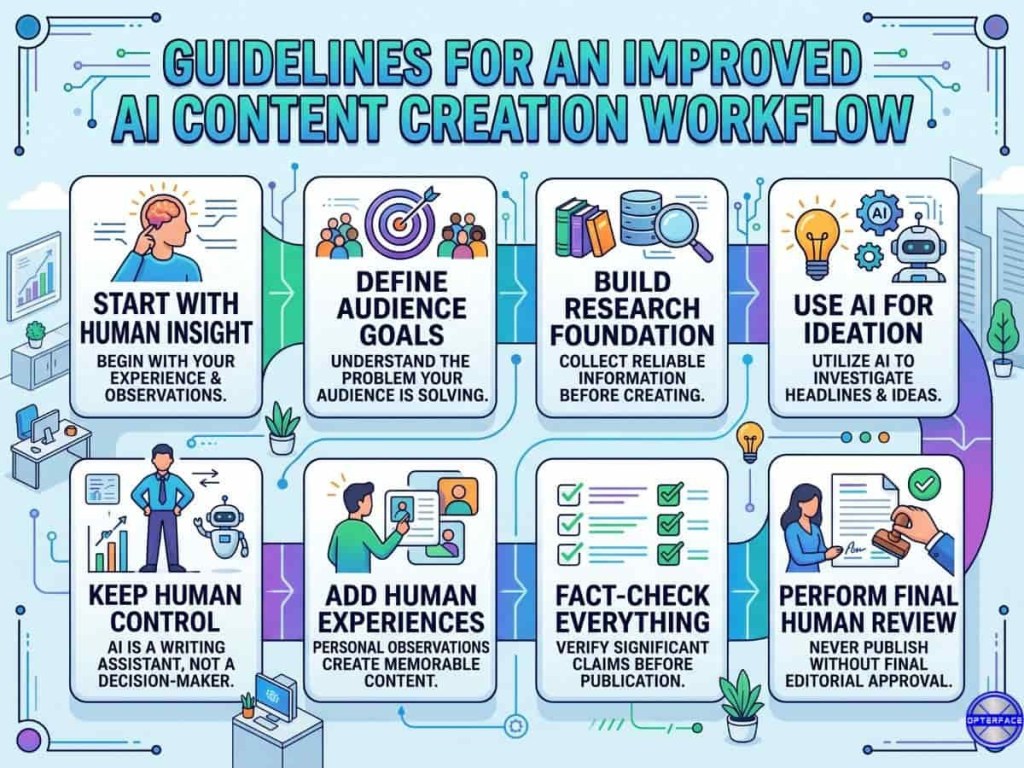
If you want to improve your AI content creation process, follow these practical guidelines.
- Begin with Human Insight: Before you begin using any AI tool, start with your own observations, experiences, and expertise.
- Define Your Content Goal: Understand the exact problem your audience is attempting to solve.
- Build a Strong Research Foundation: Collect reliable information before creating content.
- Use AI for Ideation: Utilise AI to investigate headlines, angles, subtopics, and supporting ideas.
- Create a Strategic Outline: Before you start writing, organise your content structure.
- Keep Human Control: Consider AI as a writing assistant rather than a decision-maker.
- Identify Information Gaps: Use AI to pinpoint areas that need further research.
- Add Human Experiences: Personal observations make content more memorable.
- Prioritize Audience Value: Instead of increasing word count, focus on problem-solving.
- Write for Real People: Keep the language simple, conversational, and easy to understand.
- Fact-Check Everything: Never publish significant claims without verification.
- Align with Your Brand Voice: Maintain consistency throughout all content.
- Remove Generic Content: Replace ambiguous statements with actionable insights.
- Improve Readability: Break down complex concepts into simple explanations.
- Balance SEO and User Experience: While optimisation is important, usefulness is even more important.
- Refine with AI Editing: Use artificial intelligence to improve grammar, structure, and clarity.
- Ensure Contextual Accuracy: Compare recommendations to real-world situations.
- Add Original Perspectives: Create insights that your competitors will find difficult to replicate.
- Validate Audience Relevance: Confirm that your content responds to genuine audience questions.
- Perform a Final Human Review: Never publish content without final editorial approval.
- Measure and Improve Performance: Analyse engagement and tailor future content accordingly.
- Use AI to Amplify Creativity: The most effective AI workflows enhance rather than replace human creativity.
FAQs on AI Content Creation Process
As AI becomes more integrated into modern content marketing, many questions arise about its limitations, effectiveness, accuracy, and best practices.
The frequently asked questions below address some of the most common concerns marketers and content creators have about the AI content creation process and how to make it more effective.
What is the problem with AI-generated content?
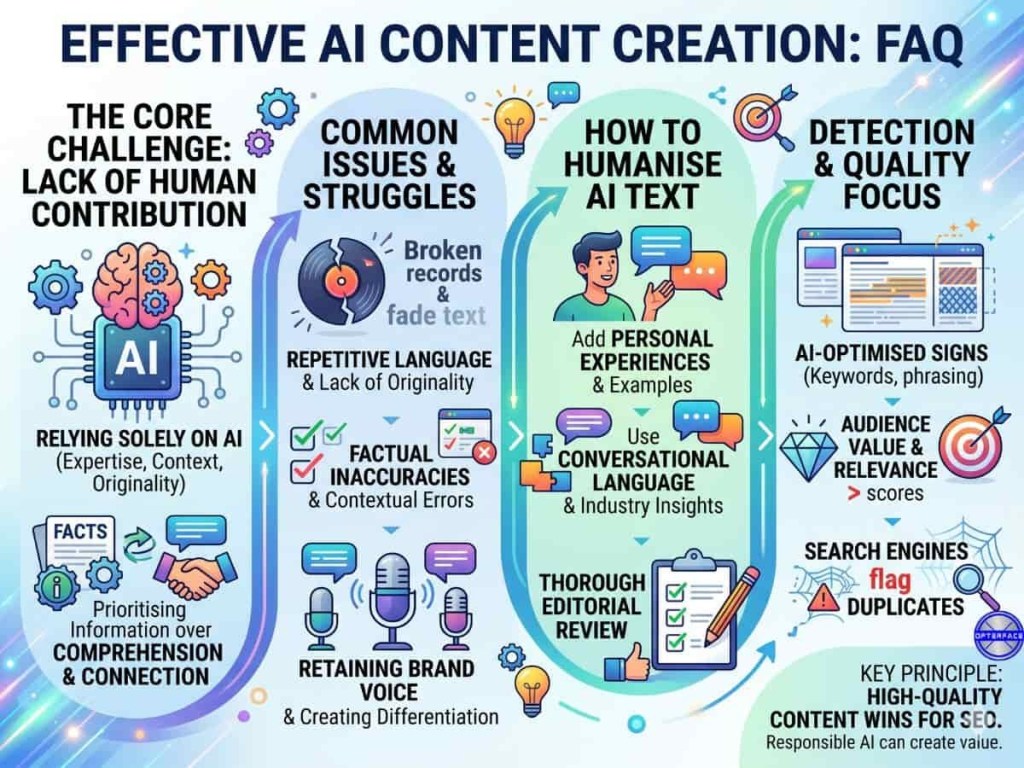
The main issue with AI-generated content isn’t the technology itself. The problem arises when creators rely solely on AI without providing expertise, context, or original thinking.
What are common problems with AI-generated content?
Common issues include repetitive language, factual inaccuracies, poor audience connection, a lack of originality, and contextual errors.
How to make AI-generated text sound more human?
Include personal experiences, practical examples, conversational language, industry-specific insights, and a thorough editorial review.
What is the issue with AI content?
The main issue with AI content is that it frequently prioritises information delivery over true comprehension and human connection.
How to identify AI-optimized articles?
AI-optimized articles frequently use repetitive phrasing, generic explanations, excessive keyword focus, and a lack of unique perspectives.
What are the biggest struggles you face when creating content with AI?
Most marketers struggle to maintain originality, ensure factual accuracy, retain brand voice, and create meaningful differentiation.
What is a good AI detection score?
There is no universal benchmark. The true focus should be on quality, relevance, and audience value, not detection scores.
Can a website detect copy and paste?
Many platforms and search engines can detect duplicate or nearly identical content patterns.
Does AI content marketing negatively impact SEO?
Not necessarily. Poor-quality content degrades SEO, regardless of whether AI was used. When used responsibly, AI can produce high-quality, useful content.
Final Words on the AI Content Creation Process
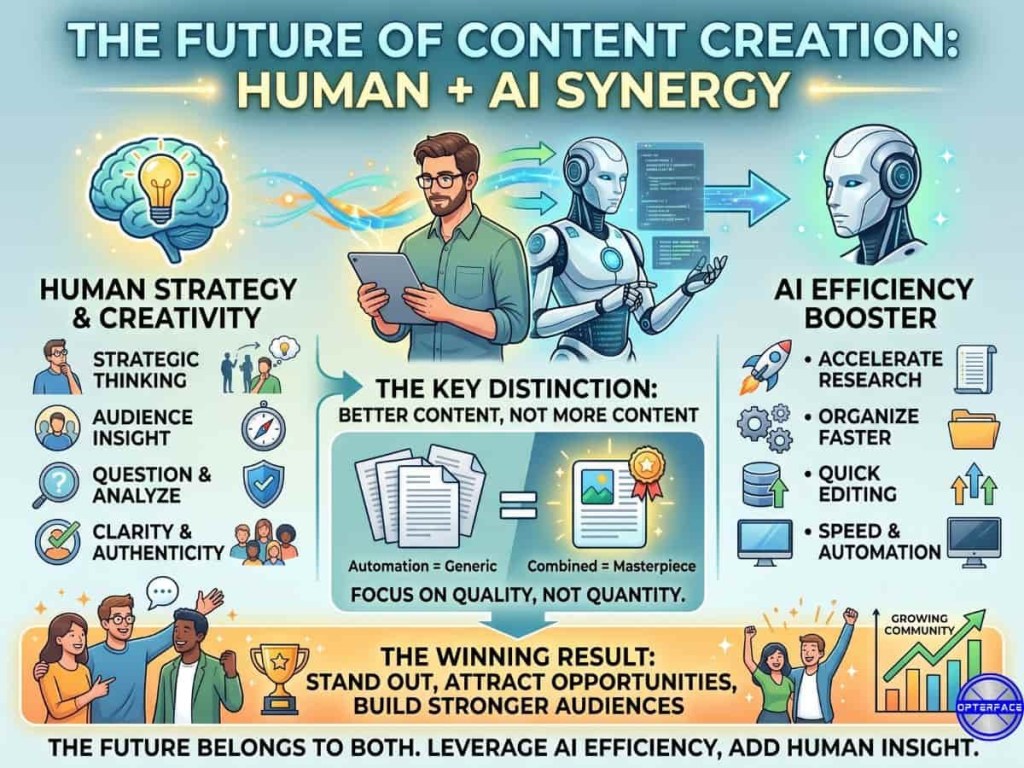
The future of content creation belongs to both humans and artificial intelligence. It belongs to those who know how to combine both.
The actual issue with the AI content creation process has never been AI itself. The issue arises when creators view AI as a replacement for expertise, creativity, and critical thinking.
Audiences don’t engage with content just because it exists. They interact with content because it helps them solve problems, make decisions, and learn new things.
As artificial intelligence advances, creating content will become easier than ever before. Ironically, this makes genuine human insight even more valuable.
When everyone has equal access to the same tools, technology no longer serves as a differentiator. The person who employs the technology becomes the differentiator.
The most successful marketers won’t automate everything. They will be the ones to strategically use AI while maintaining the human qualities that foster trust and credibility.
Use artificial intelligence to accelerate research. Use artificial intelligence to organise faster. Use AI to edit more quickly. However, never let AI replace your ability to think, observe, question, analyse, and comprehend your audience.
Finally, readers are still human beings. They seek clarity. They seek relevance. They want authenticity. And these are characteristics that no automation system can completely replicate.
The most effective AI content creation process does not involve creating more content. It’s about producing better content.
Marketers who understand this distinction will continue to stand out, attract better opportunities, and build stronger audiences in an increasingly AI-powered world.

