
Learn how NVIDIA became the world’s leading graphics card brand and transformed into an AI technology giant by expanding far beyond gaming.
Introduction to NVIDIA Case Study
Imagine developing a product for one market only to discover years later that it solves a much larger problem nobody anticipated. This is exactly what happened in this NVIDIA Case Study.
A company that was once almost exclusively associated with gaming graphics cards now powers artificial intelligence, self-driving cars, robotics, scientific research, healthcare, cloud computing, and advanced data centres.
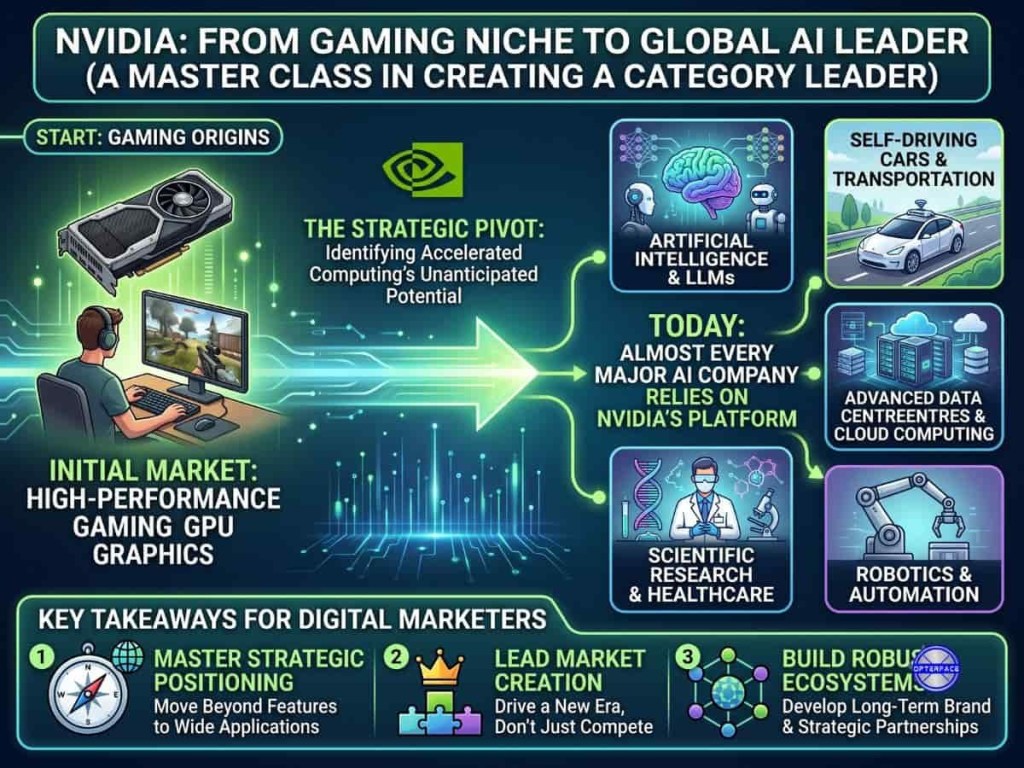
Today, almost every major AI company relies on NVIDIA’s computing platform. For digital marketers, this story extends far beyond technology. It’s a master class in positioning, market creation, ecosystem development, and long-term brand strategy.
If you want to learn how category leaders are created rather than simply competing in existing markets, this journey provides valuable insights.
TL;DR
NVIDIA Case Study: NVIDIA did not become one of the world’s most valuable companies solely because it produced superior graphics cards. It became a technology behemoth because it saw a future that others overlooked.
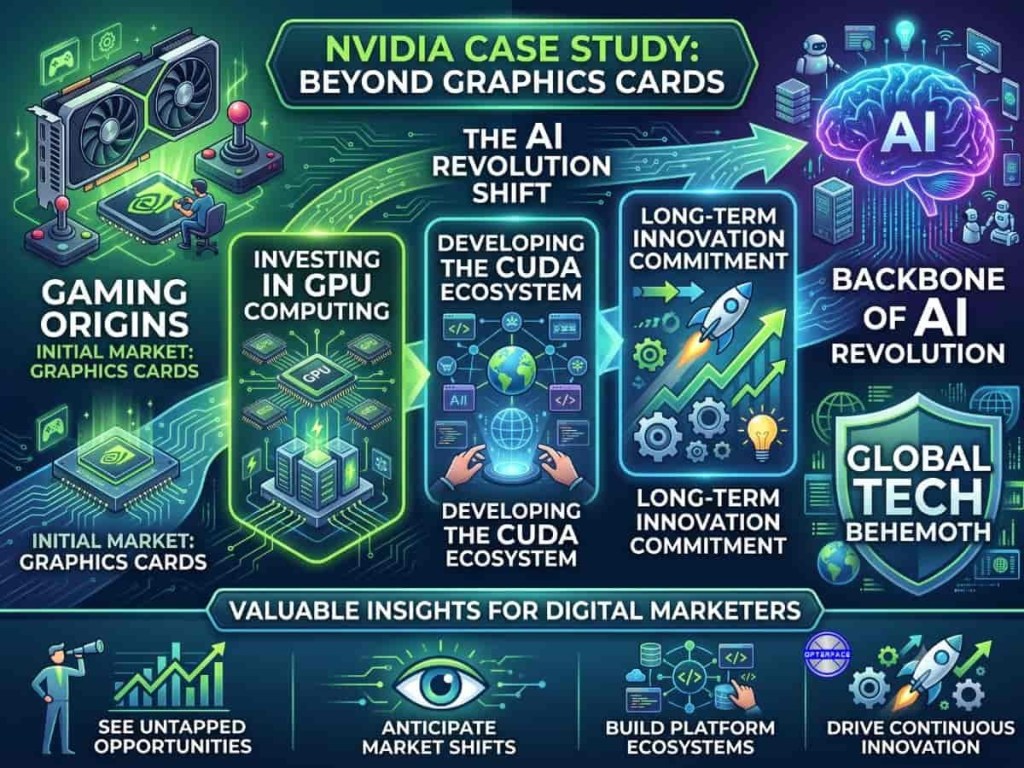
NVIDIA transformed itself from a gaming hardware company to the backbone of the AI revolution by investing in GPU computing, developing the CUDA software ecosystem, and remaining committed to long-term innovation.
This case study delves into the strategies, business decisions, marketing lessons, and competitive advantages that all digital marketers can benefit from.
Why Is This NVIDIA Case Study So Important?
The short answer is that NVIDIA helped create a market rather than waiting for one to exist. Most businesses concentrate on competing with existing demand. NVIDIA followed a different path.
Instead of asking, “How do we sell more graphics cards?” the question was, “What else can graphics processors solve?” That single shift altered everything.

Today, NVIDIA is one of the world’s most influential technology companies because it has developed technology that powers industries rather than serving a single industry. For marketers, this is the distinction between selling a product and developing a platform.
The Beginning: Three Engineers, One Vision
Every successful business begins with an idea, but not all ideas survive the early years. NVIDIA was founded in 1993 by three engineers with a single ambitious goal: to create specialized processors capable of handling advanced computer graphics.
At the time, CPUs were the primary source of computing power, processing tasks sequentially. Graphics hardware was considered a niche market, primarily for gamers.

Their vision challenged traditional thinking. While many companies competed to build faster CPUs, NVIDIA believed that graphics processors would eventually become an essential component of computing itself.
That belief seemed risky. Few investors understood why dedicated graphics chips were important, and the young company faced stiff competition from dozens of semiconductor startups entering the same market.
Early Failures Nearly Ended the Company
Many successful companies had a difficult start. NVIDIA was no exception. Its first multimedia processor did not meet expectations. Customers were dissatisfied, commercial partnerships failed, and financial pressure grew rapidly. At one point, the company had only a few weeks of operating cash left.
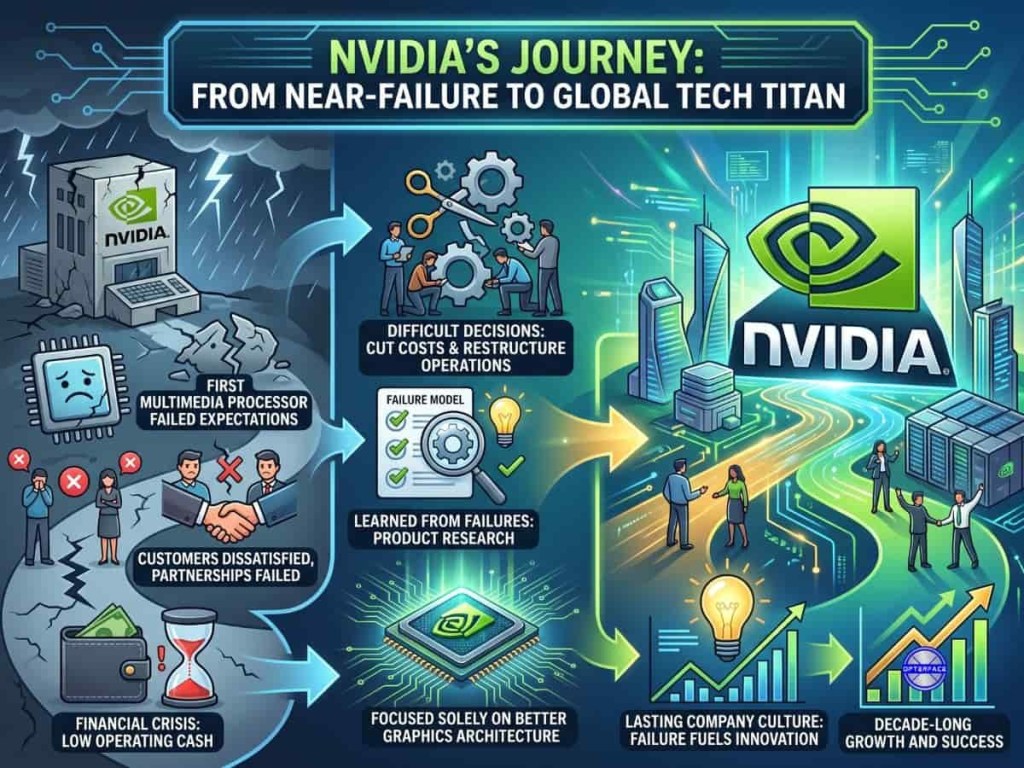
Instead of abandoning its vision, the team faced difficult decisions. They cut costs, restructured operations, learned from product failures, and focused solely on creating a better graphics architecture. NVIDIA treated failure as product research rather than the end. That mindset would shape the company culture for decades.
The First Major Breakthrough Changed Everything
Every great company goes through a turning point. For NVIDIA, that moment arrived with the release of its next-generation graphics processors. These products delivered significantly higher graphics quality and performance than many competing solutions, leading to widespread adoption among gamers and computer manufacturers.

The momentum continued. By 1999, NVIDIA had introduced what it claimed was the world’s first Graphics Processing Unit. More importantly, it marketed the GPU as a new computing category, not just another graphics chip.
The branding decision was important. Instead of competing in an already established market, NVIDIA invented a new language for the industry.
GPU vs CPU: Why the Difference Changed Computing
Understanding this distinction explains virtually everything about NVIDIA’s success.
1. Processing Approach:
- A Central Processing Unit (CPU) is designed to process tasks sequentially. It excels at handling fewer, more complex operations that require decision-making and flexibility, making it the best choice for everyday computing tasks such as system administration, web browsing, and application management.
- In contrast, a graphics processing unit (GPU) is designed for parallel processing. Instead of focusing on a few complex tasks, it can perform thousands of simpler calculations concurrently. This architecture enables GPUs to perform exceptionally well in graphics rendering, artificial intelligence (AI), scientific simulations, machine learning, and other computationally intensive workloads.
2. Best Use Cases:
- CPUs are the foundation of general-purpose computing because they can efficiently handle a wide range of instructions and workloads. They are in charge of coordinating system operations, executing software logic, and managing tasks that require sequential processing.
- GPUs, on the other hand, are designed specifically for workloads that require a lot of computing power. They excel in applications such as 3D graphics, AI model training, video rendering, scientific computing, and large-scale simulations, where thousands of operations can be performed simultaneously.
3. Simple Analogy:
- A CPU acts as an experienced project manager. It carefully plans, prioritizes, and executes a single complex task at a time with precision.
- A GPU is analogous to thousands of workers working on the same project simultaneously. Each worker does a smaller task, but together they can complete massive workloads much faster than a single manager could.
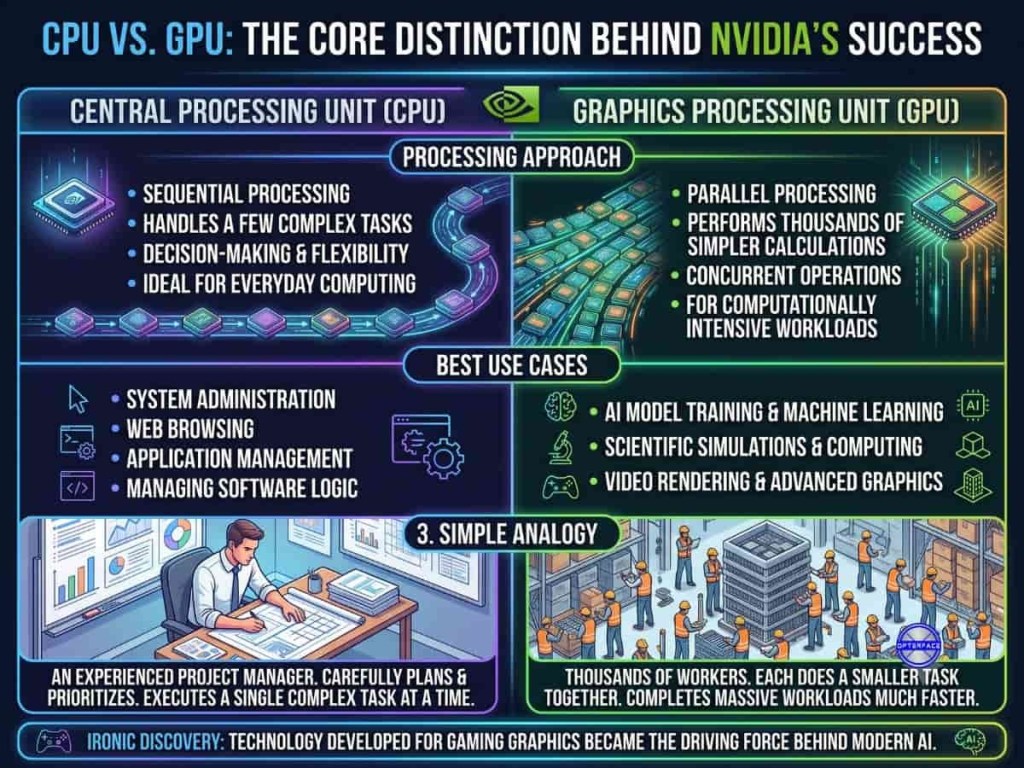
Consider a CPU as a single expert who solves problems one at a time. Consider thousands of workers tackling thousands of smaller problems at once. This is what a GPU does. Originally, this feature made games appear smoother and more realistic.
Years later, researchers discovered that the same architecture was ideal for training artificial intelligence. Ironically, the technology developed for gaming would become the driving force behind modern AI.
The Strategic Decision Most Competitors Missed
Many companies succeed because they create excellent products. NVIDIA succeeded because it created an ecosystem. Rather than limiting GPUs to gaming, the company made significant investments in software that enabled developers, researchers, universities, and engineers to use graphics processors for scientific computing and machine learning.
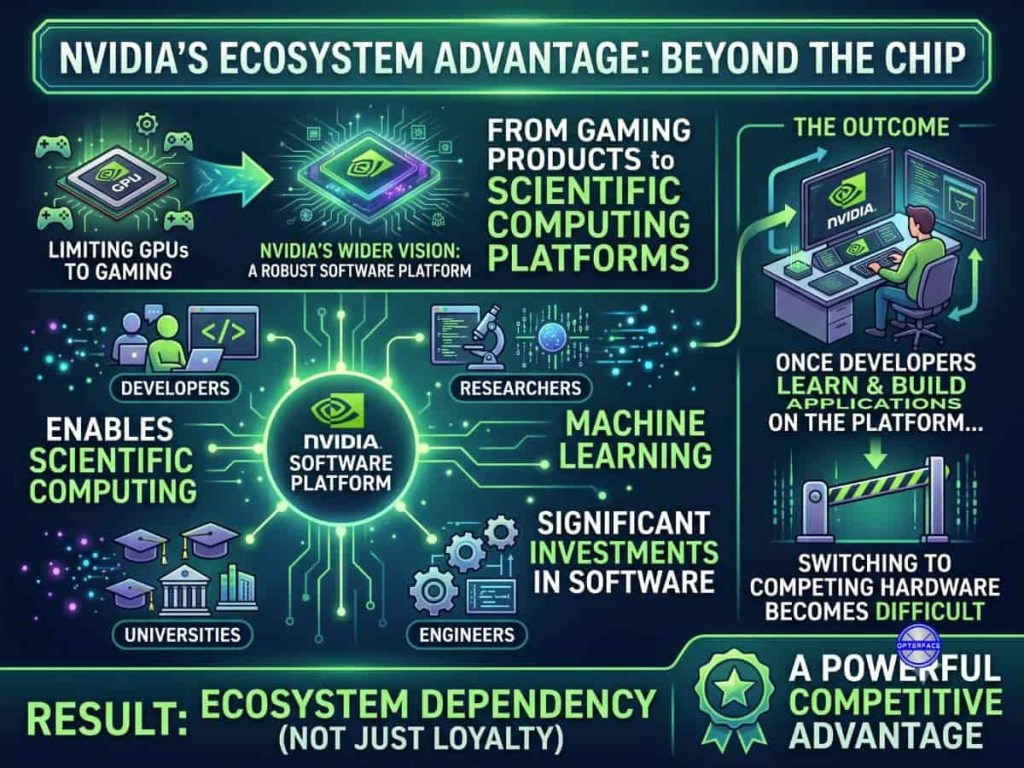
This software platform ultimately became one of NVIDIA’s most significant competitive advantages. Once developers had learned the platform and built applications around it, switching to competing hardware became more difficult. The outcome was not just customer loyalty. It was due to ecosystem dependency.
Why Building an Ecosystem Beats Building Products
Many businesses are focused on the next product launch. Platform companies think differently. NVIDIA realized that hardware alone would eventually become commoditized. Software, developer communities, research collaborations, and enterprise integrations created significantly more long-term value.

This approach transformed NVIDIA from a hardware manufacturer to an infrastructure provider. Today, organizations do not simply purchase NVIDIA chips. They adopt the entire computing ecosystem. That distinction represents one of the most important strategic lessons for digital marketers.
Lesson for Digital Marketers from this NVIDIA Case Study
Instead of saying, “How can I sell more products?”
Ask: “How can I build an ecosystem people don’t want to leave?”
The ecosystem could include:
- Educational content
- Communities
- Software integrations
- Certification programs
- Templates
- Exclusive resources
- Strategic partnerships
Products generate transactions. Ecosystems create long-term relationships.
A Hidden Marketing Lesson Most Brands Overlook
One of the most important takeaways from the NVIDIA Case Study has nothing to do with semiconductors. NVIDIA rarely gained popularity through flashy consumer advertising. Instead, it gained trust by resolving increasingly complex technical issues for developers, researchers, universities, AI labs, and enterprise customers.
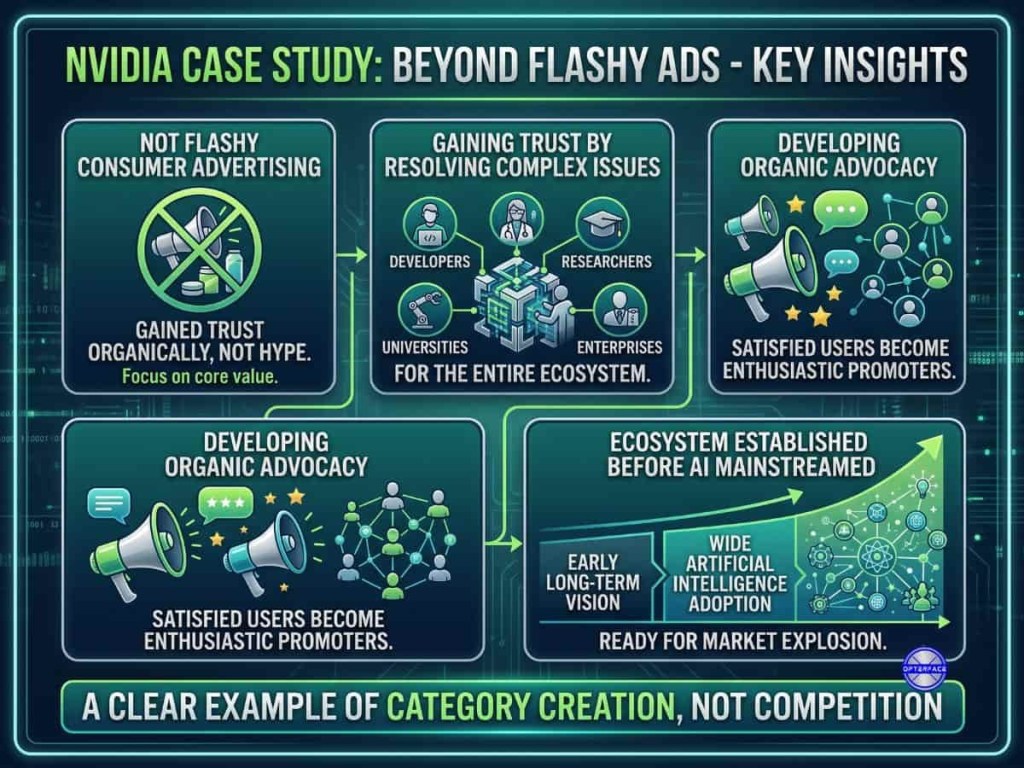
That resulted in organic advocacy. Years later, when artificial intelligence became widely used, the ecosystem had already been established. The market has simply caught up with the company’s long-term vision. This is one of the most obvious instances of category creation rather than category competition.
How CUDA Became NVIDIA’s Biggest Competitive Advantage
Most people believe that NVIDIA’s main advantage is its hardware. The reality is different. Its most significant competitive advantage is the software ecosystem built around its GPUs. This ecosystem enables developers, researchers, enterprises, and AI companies to create applications that run smoothly on NVIDIA hardware.

Instead of simply producing chips, NVIDIA created an environment in which innovation could occur more quickly. That strategy provided an advantage that competitors are still struggling to replicate.
Why the Software Platform Changed Everything
When researchers began to use GPUs for scientific computing rather than gaming, NVIDIA saw an unexpected opportunity. Rather than ignoring this new audience, the company invested in software that enabled developers to create programs tailored to GPU computing. This decision took NVIDIA well beyond gaming.
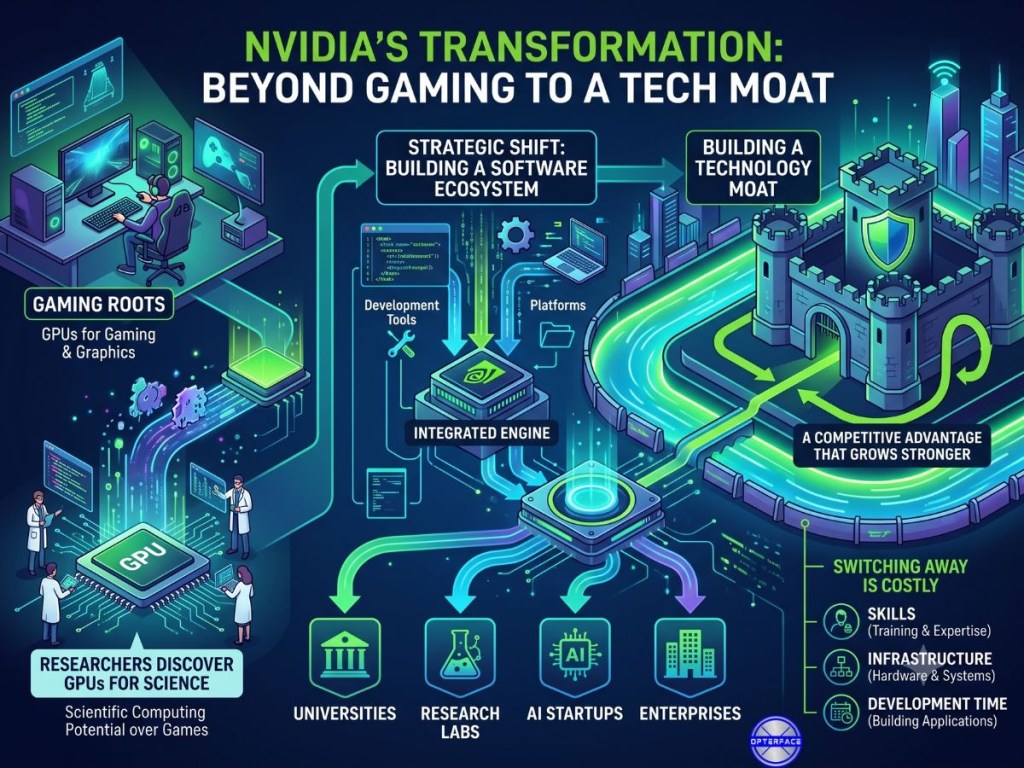
Universities began teaching GPU programming, research labs adopted the platform, AI startups built on it, and enterprise organizations incorporated it into their workflows. Over time, switching away became more expensive in terms of skills, infrastructure, and development time. This is referred to as creating a technology moat, which is a competitive advantage that grows stronger as more people use the ecosystem.
The AI Revolution Changed NVIDIA Forever
NVIDIA’s success was not driven by artificial intelligence. Instead, AI accelerated decades of preparation. Long before generative AI became popular, researchers discovered that GPUs were ideal for training deep learning models because they could perform thousands of calculations simultaneously. As AI models grew in size and complexity, the demand for GPU computing increased significantly.
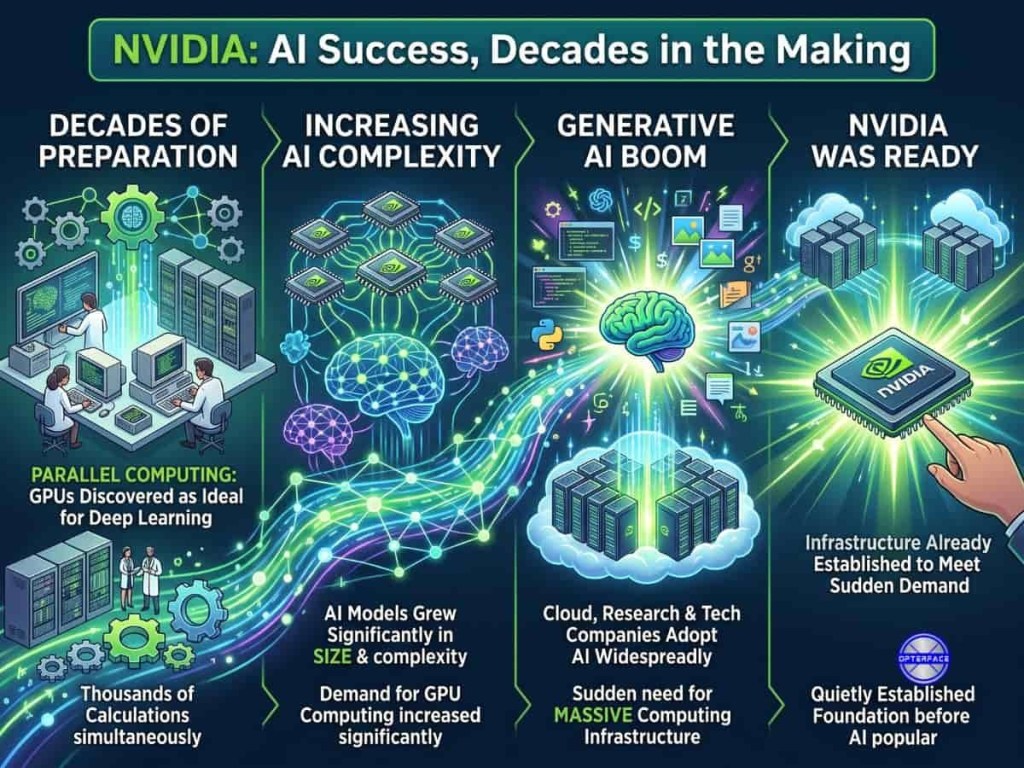
When generative AI tools became widely used, cloud providers, research organizations, and technology companies suddenly required massive computing infrastructure. NVIDIA was already prepared to meet the demand. Instead of chasing the AI trend, the company quietly established the foundation for it.
NVIDIA’s Business Evolution
The transformation of NVIDIA is one of the most obvious examples of strategic expansion rather than complete reinvention.
Business Evolution: NVIDIA’s transformation did not mean abandoning gaming; rather, it meant expanding its core expertise into industries with far greater long-term potential. What began as a company focused on gaming graphics has grown into a technology leader in artificial intelligence, enterprise computing, and advanced digital infrastructure.
From Gaming to AI: In its early years, NVIDIA was best known for designing gaming graphics cards that provided smoother visuals and improved gaming performance. Today, its GPUs form the basis of modern AI infrastructure, enabling organizations to train, deploy, and scale sophisticated AI models.
From Consumer Products to Enterprise Solutions: Initially, NVIDIA’s primary customers were gamers and PC enthusiasts who purchased consumer hardware. Today, the company creates enterprise-grade platforms for cloud providers, research institutions, healthcare organizations, financial services firms, automotive manufacturers, and AI companies to solve complex computational challenges.

From Graphics Processing to High-Performance Computing: NVIDIA’s initial focus was on graphics acceleration, which enabled computers to render realistic 2D and 3D visuals more efficiently. As computing requirements changed, the same GPU architecture proved ideal for data centre computing, enabling AI training, scientific simulations, cloud computing, and large-scale analytics.
From a Gaming Community to an AI Ecosystem: The company’s success was once heavily reliant on the gaming ecosystem, which included gamers, game developers, and hardware vendors. Today, NVIDIA supports a much larger AI ecosystem that includes software developers, universities, research laboratories, cloud providers, startups, enterprise organizations, and technology partners who work together to accelerate AI innovation.
From Hardware Manufacturer to Full-Stack Technology Platform: NVIDIA was once thought of primarily as a hardware company that produced graphics processors. It has now evolved into a full-stack computing platform that combines advanced GPUs with software frameworks, AI platforms, networking technologies, cloud services, developer tools, and strategic partnerships to provide comprehensive AI and accelerated computing solutions.
This evolution exemplifies a fundamental business principle. Companies rarely achieve industry leadership by abandoning their strengths. They grow by extending their strengths into adjacent markets.
Beyond Gaming: How NVIDIA Expanded Its Business
Gaming remains an important part of NVIDIA’s identity, but it is no longer the company’s primary growth driver. Today, the company operates in several high-value industries, including:
- Artificial Intelligence: GPUs enable AI model training and inference.
- Data Centres: Large cloud providers use GPU clusters for AI workloads.
- Healthcare: Accelerated computing helps with medical imaging, genomics, and drug discovery.
- Automotive: AI platforms contribute to the development of advanced driver assistance and self-driving technology.
- Robotics: AI-powered robots rely on GPU computing for perception and decision-making.
- Scientific Research: GPUs are being used in universities and laboratories to accelerate simulations.
- Industrial Digital Twins: Businesses simulate factories, supply chains, and manufacturing processes before deploying them in the real world.
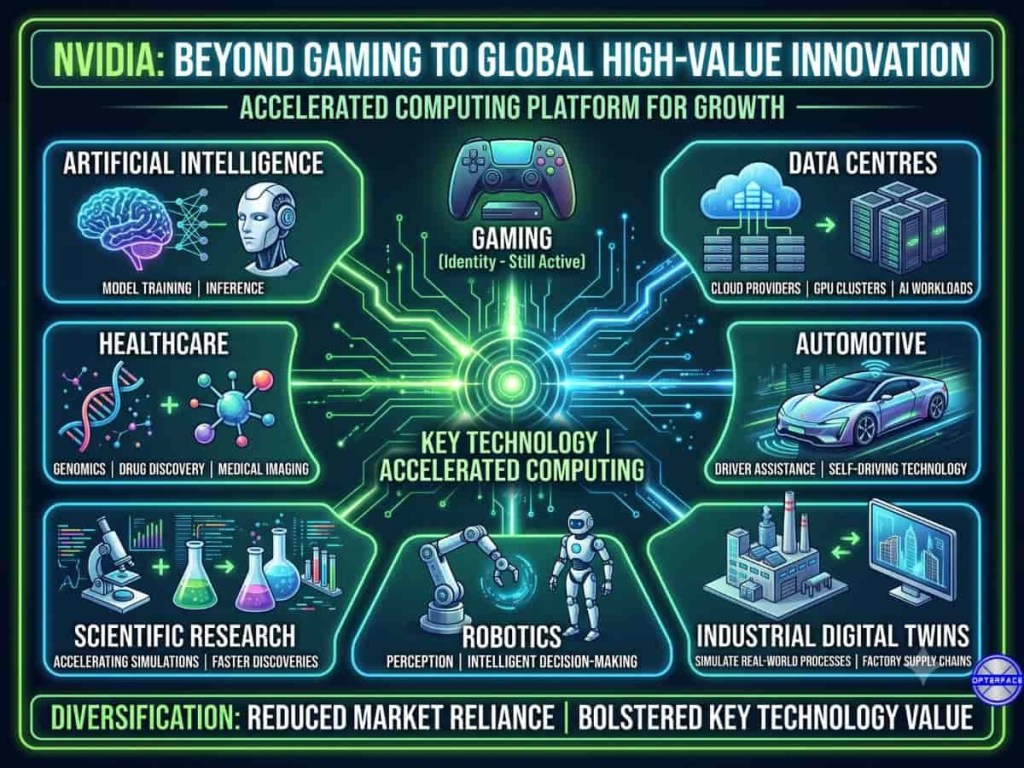
This diversification reduced the company’s reliance on a single market while bolstering the value of its key technology.
What Every Dreamer Can Learn from this NVIDIA Case Study
This NVIDIA Case Study teaches valuable lessons that go well beyond technology.
1. Solve Bigger Problems Than Your Original Product
NVIDIA began with gaming. Its long-term success stemmed from identifying broader applications for the same technology.
Ask yourself: “Can my product solve problems outside its current audience?”
Sometimes your next market already exists; you just haven’t identified it yet.
2. Build a Category Instead of Competing in One
Several brands compete for market share. Few create entirely new markets. NVIDIA helped to reposition graphics processors as essential computing infrastructure rather than optional gaming accessories. Creating a category frequently provides more long-term value than winning within an existing one.
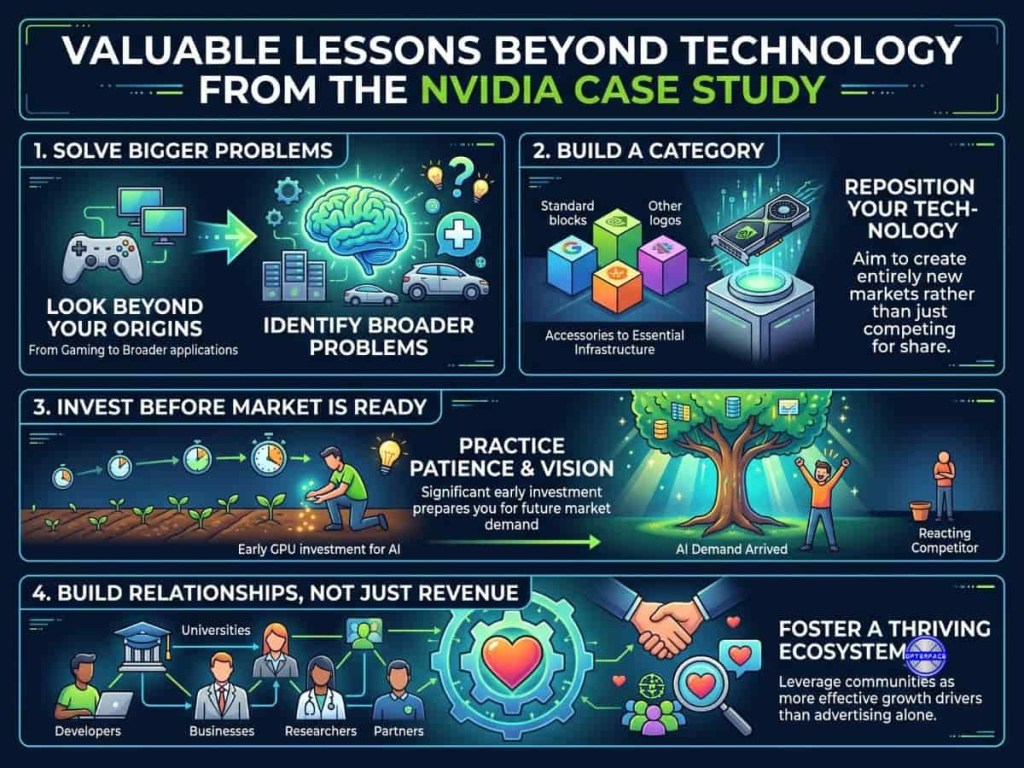
3. Invest Before the Market Is Ready
Patience was one of NVIDIA’s biggest strengths. Years before artificial intelligence became commercially viable, the company made significant investments in GPU computing. When market demand arrived, NVIDIA was ready, while many competitors were still reacting. Long-term thinking frequently outperforms short-term optimization.
4. Build Relationships, Not Just Revenue
Developers, researchers, universities, businesses, and strategic partners all contributed to NVIDIA’s ecosystem. These relationships fostered trust, accelerated adoption, and boosted the company’s competitiveness. The same principle applies to digital marketing. Communities are often more effective growth drivers than advertising alone.
Practical Scenario
Assume you run a content marketing agency. Your main service is SEO content writing. Rather than simply selling articles, you create:
- A content strategy framework.
- Keyword research templates.
- AI optimization checklists.
- Training resources.
- Client dashboards.
- Performance reporting.
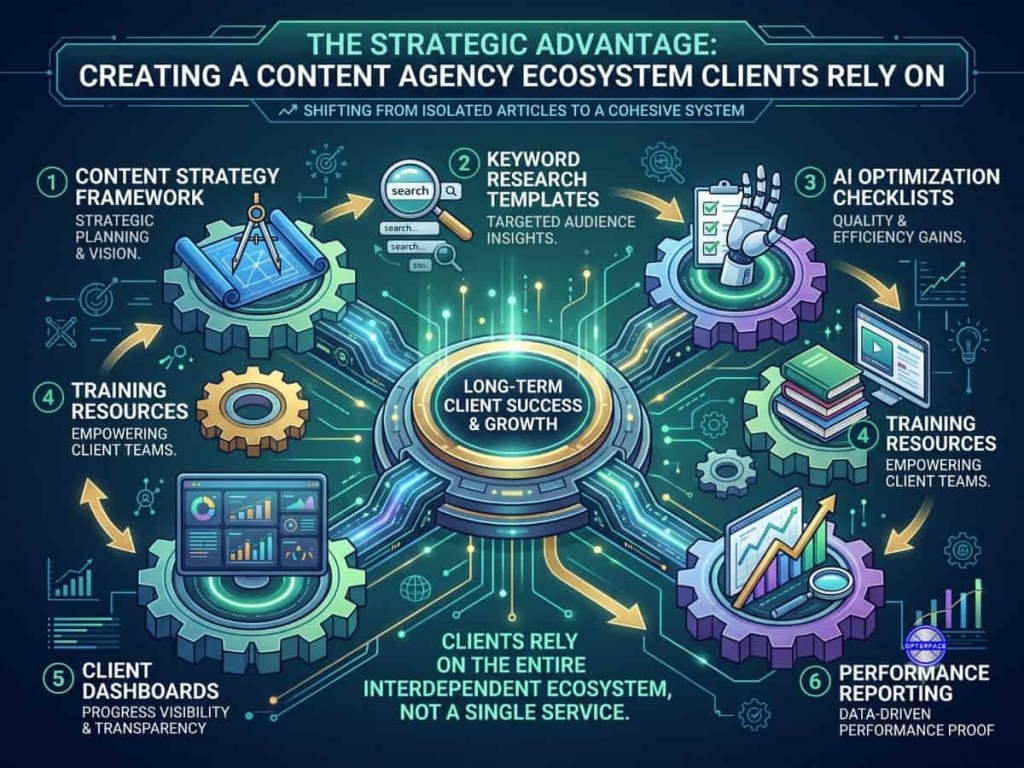
Eventually, clients will rely on your entire ecosystem rather than a single service. This reflects the strategic thinking demonstrated throughout the NVIDIA Case Study.
Expert Advice
Focus on ecosystems: Products entice customers. Ecosystems preserve them.
Pay attention to unexpected users: Sometimes your ideal market finds you before you find it.
Think in decades, not quarters: Long-term investments frequently produce exponential returns.
Create switching value ethically: Provide enough ongoing value to keep customers.
Stay curious: Customers frequently use your product in unexpected ways, which sparks innovation.
Key Takeaways
- NVIDIA transitioned from a gaming hardware company to a global computing platform.
- Early failures provided opportunities for continuous improvement.
- GPUs opened up new possibilities beyond gaming.
- Software and developer ecosystems have gained significant competitive advantages.
- AI accelerated NVIDIA’s growth because decades of planning had already been done.
- Strategic partnerships aided market adoption.
- Long-term thinking has consistently outperformed short-term decision-making.
- Branding, positioning, and customer retention can all be approached by digital marketers using the same principles.
FAQs on this NVIDIA Case Study
Do you still have questions? Here are clear, concise answers to the most frequently asked questions about NVIDIA’s expansion, strategy, and business transformation beyond gaming.
What is the biggest lesson from this NVIDIA Case Study?
The most important lesson is that sustainable growth requires solving increasingly valuable problems while constantly expanding your ecosystem, rather than relying on a single product.
Why did NVIDIA become successful beyond gaming?
The company recognized the potential applications of GPU technology in scientific computing, artificial intelligence, healthcare, robotics, cloud computing, and a variety of other industries.
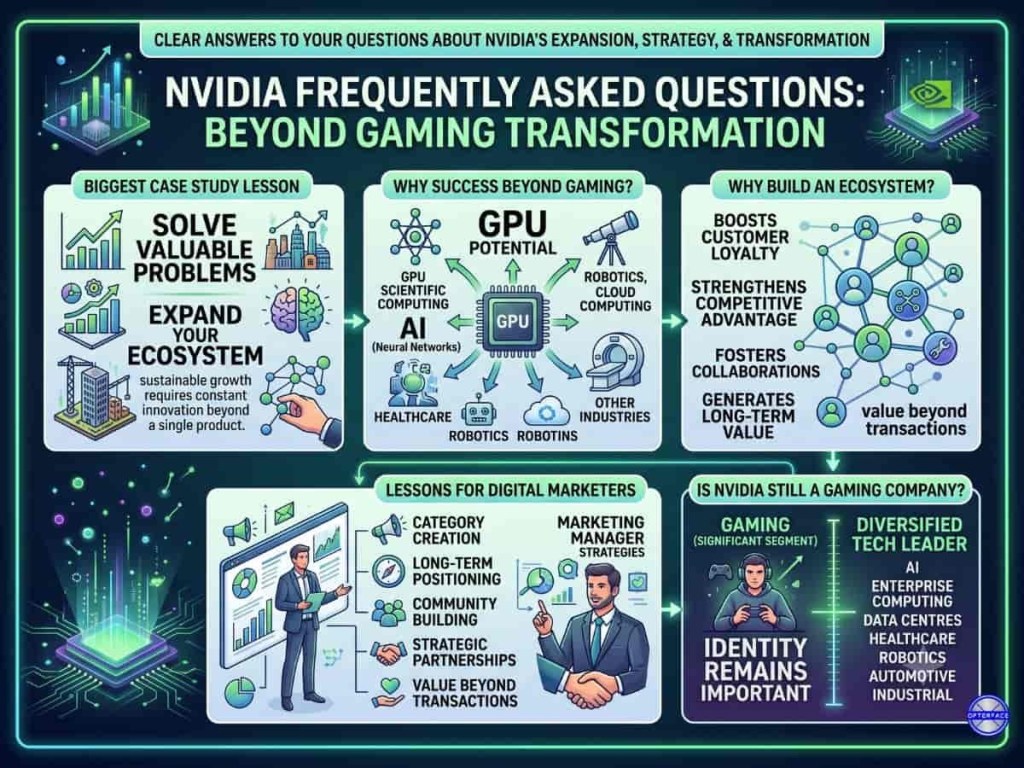
Why is ecosystem building important?
An ecosystem boosts customer loyalty, strengthens competitive advantages, fosters collaborations, and generates long-term business value beyond individual products.
What can digital marketers learn from NVIDIA?
Digital marketers can learn about category creation, long-term positioning, community building, strategic partnerships, and providing value beyond transactional services.
Is NVIDIA still a gaming company?
Gaming remains a significant business segment, but NVIDIA has diversified into AI, enterprise computing, data centres, healthcare, robotics, automotive technologies, and industrial computing.
Conclusion on the NVIDIA Case Study
This NVIDIA Case Study demonstrates that extraordinary businesses rarely succeed by following established markets. They succeed by identifying opportunities that others miss and committing to a vision long before the rest of the world realizes it. For digital marketers, the lesson is obvious. Winning doesn’t always mean creating more content, launching more campaigns, or following every trend.
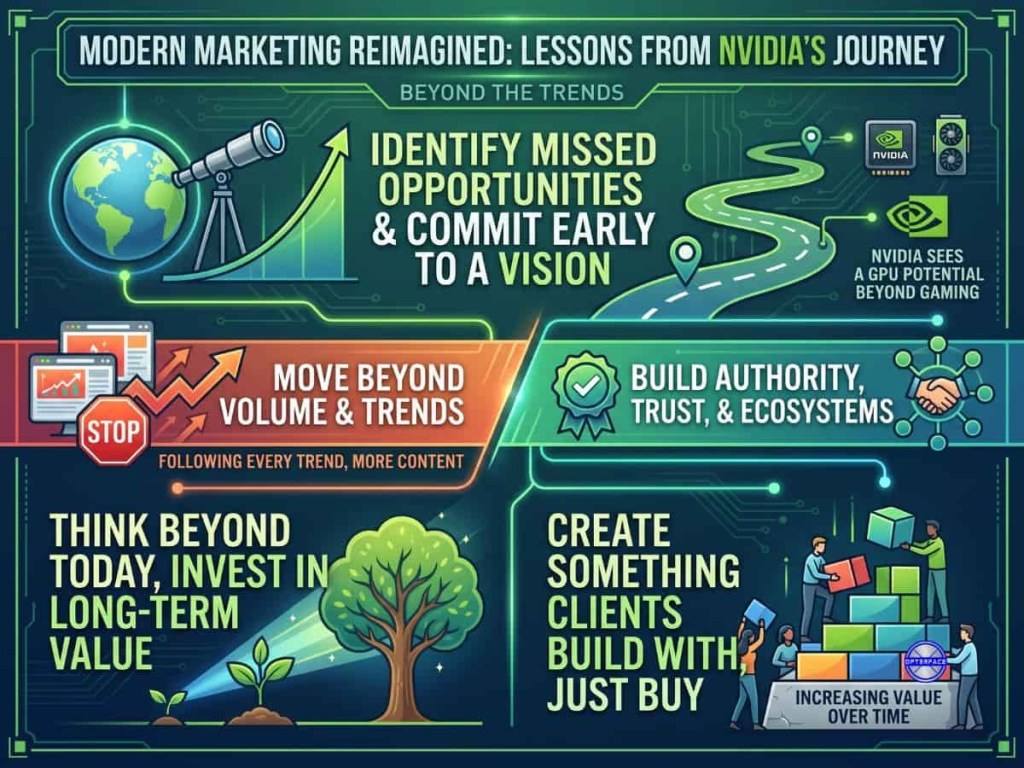
It’s about establishing authority, gaining trust, creating an ecosystem, and solving problems that increase in value over time. Whether you’re starting a personal brand, expanding an agency, or scaling a business, the principles underlying NVIDIA’s journey are remarkably applicable. Think beyond today’s opportunities, invest in long-term value, and create something that people want to build with rather than just buy.
Suggested Reads:
How to Rank on AI Overviews: Boost Your AI Visibility & Authority
Problems with AI Content Creation Process and Their Fixes
Digital Marketing Trends in 2026: Process of Content Creation to Win
The Digital Marketing Mindset for 2026 and Beyond: What Truly Matters?

